Valentine’s Day Party Supplies Wholesale: Planning a February Sell-Through

Valentine’s Day party supplies wholesale buying can be difficult because the selling period is short and demand can fade quickly after the holiday. I have seen buyers focus too heavily on unit cost, then face late arrivals or leftover stock. A focused range, clear specifications, and early delivery planning can reduce that risk.
Valentine’s Day party supplies wholesale works best when buyers build a tightly coordinated range of reusable heart-themed decorations, party items, and gift-ready accents, then place orders early enough for stock to reach shelves before late January. I recommend shallow depth, controlled SKU counts, fast sampling, and replenishment options instead of broad speculative buying for a three-week sales window.
The strongest February programs do not need hundreds of unrelated items. I recommend using a few visual anchors, supporting them with practical add-on products, and checking every material, dimension, finish, MOQ, and lead time before purchase approval. The sections below explain how I would evaluate the range and delivery plan.
Quick Answer: How Should Buyers Plan Valentine’s Day Party Supplies Wholesale?
A short seasonal window creates pressure for importers and distributors. Over-ordering can tie up warehouse space after 14 February, while late delivery can remove most of the selling opportunity. I recommend planning Valentine’s Day party supplies wholesale around a small, coordinated assortment that lands before late January.
Buyers should select a controlled number of heart-led designs in red, pink, white, and mixed materials; use door décor, banners, and lighting as visible anchor items; and confirm sampling, MOQ, production, and freight timing before placing an order. The goal is not maximum assortment depth. The goal is a clean February story with manageable inventory risk and room for replenishment.

I always treat Valentine’s Day as a commercial calendar event rather than simply a product category. The buying decision affects demand planning, packaging, retail presentation, and end-of-season clearance exposure. Buyers who align these parts early usually have more control over the final program.
Start With the Shelf Date, Not the Factory Date
The most important date is the date products must be ready for shelf placement, online fulfillment, or distributor dispatch. For many buyers, that means inventory should arrive before late January. A supplier’s quoted production completion date is only one part of the schedule.
I recommend working backward from the required arrival date:
- Set the latest warehouse arrival date.
- Allow time for receiving, quality checks, labeling, and allocation.
- Allow realistic freight and customs time based on the selected shipping method.
- Add a contingency period for sampling revisions, production delays, or booking changes.
- Confirm the order cut-off with the supplier before the range is approved.
A lower unit cost has limited value if goods miss the selling period. I would therefore compare suppliers on their ability to communicate clear lead times, support sample approval, provide packaging specifications, and discuss practical replenishment possibilities.
For short-season programs, delivery reliability is often more valuable than a minor saving on the quoted unit price.
Valentine’s Day Party Supplies Wholesale: Building a Valentine Range That Sells in Three Weeks
A broad Valentine assortment can look appealing during range planning, but each extra SKU creates inventory risk. If buyers order too deeply across too many designs, unsold goods can become a clearance problem within days. I recommend creating a concise story that customers can understand immediately.
A Valentine range should combine a small number of high-visibility decorations with supporting party and gifting products that share colours, motifs, and materials. For Valentine’s Day party supplies wholesale, heart shapes, red and pink palettes, and flexible messages usually provide a safer base than highly specific dated wording.
Build Around One Clear Visual Story
I recommend that each range begins with a simple visual direction. The theme does not need to be complicated. In fact, simple themes are often easier for retailers to merchandise across physical stores, marketplaces, social content, and gift displays.
A practical visual story may include:
- Heart motifs in large and small formats
- Red, blush pink, hot pink, white, and metallic accents
- Paper, felt, fabric, foil, and LED elements
- Romantic but broad phrases such as “Love,” “Be Mine,” or heart-only graphics
- Products that work for parties, home décor, classroom activities, and gifting displays
I would avoid making every item identical. A range needs hierarchy. Large décor pieces create impact, while smaller accessories help build basket size. For example, a buyer might combine a statement hanging decoration with coordinating paper tableware, garlands, gift bags, or party favors. The exact products should match the buyer’s retail channel, price architecture, and customer profile.
Control SKU Count and Depth
A small range can still feel complete when products coordinate well. I usually suggest separating the range into three working groups:
- Anchor SKUs
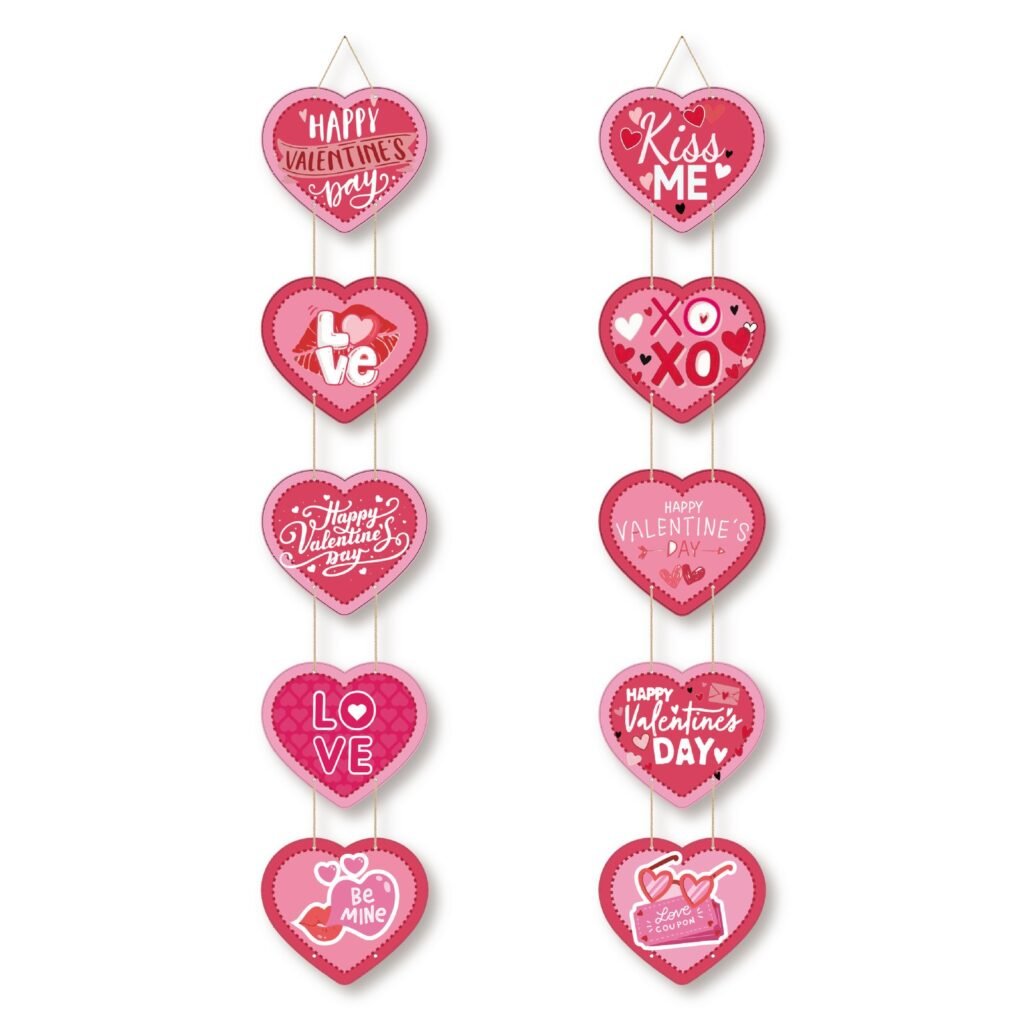
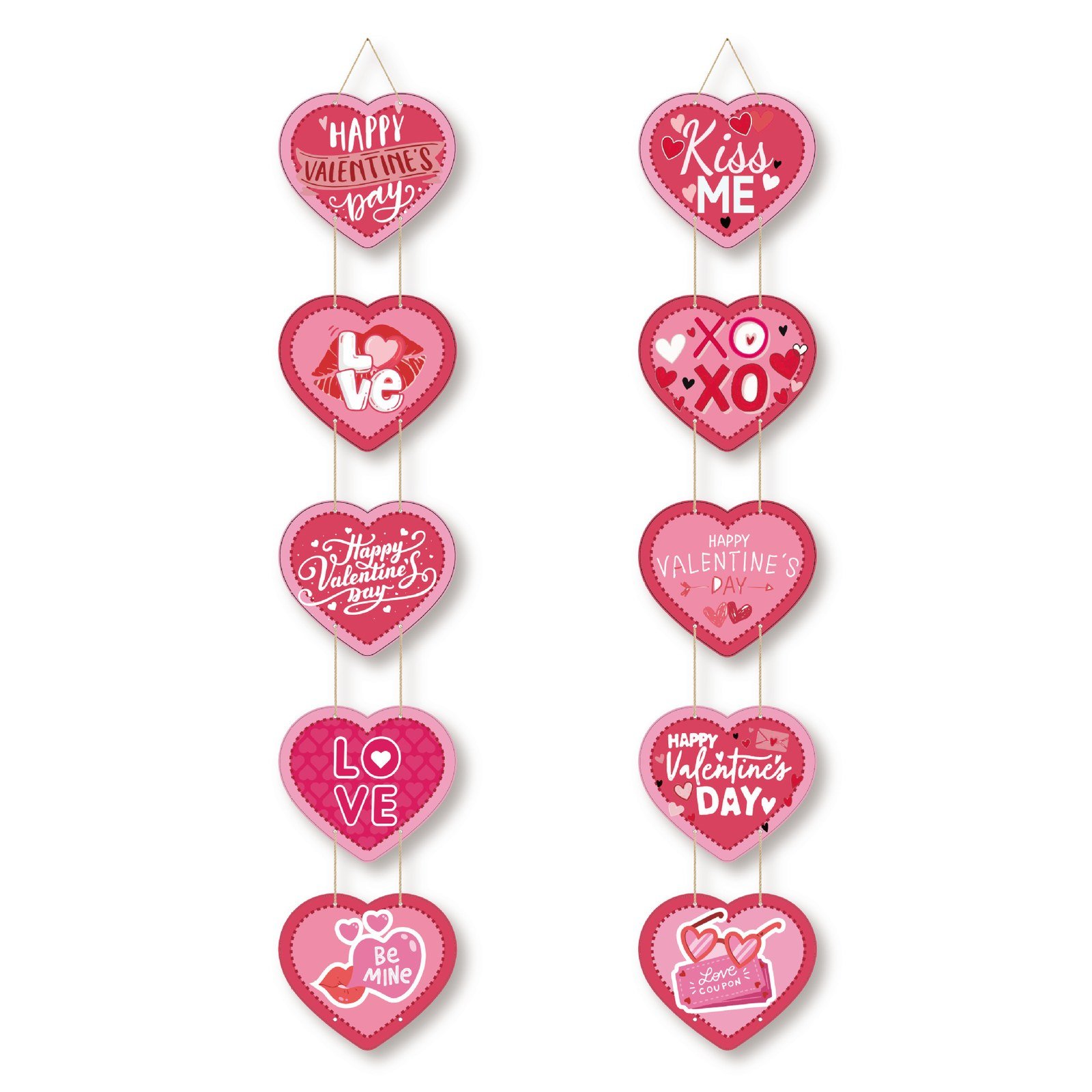
These products create visibility in a shop window, party aisle, or product listing. Examples include door hangings, bunting, large hanging hearts, and LED curtain lights.
- Supporting SKUs
These items complete the theme. Examples include garlands, paper décor, table accessories, small gift packaging, and party accents.
- Low-risk add-ons
These are compact items that may work across several selling channels. Examples include neutral heart motifs, reusable décor, and products without a year-specific message.
I would not assume that more designs automatically create more sales. A buyer should review each proposed SKU against a clear question: Does this item add a distinct customer use, visual function, or price point? If the answer is unclear, the SKU may only create complexity.
Keep Carry-Over Potential in Mind
Valentine’s Day has a fixed date, but not every Valentine product has to be disposable after 14 February. I recommend avoiding dated text such as a specific year unless the customer explicitly requires it. General heart-themed décor can sometimes be repositioned for anniversaries, weddings, engagements, romantic gifting, or general party use.
That does not eliminate inventory risk, but it can make leftover stock easier to manage. In my view, this is an important procurement consideration when selecting designs for Valentine’s Day party supplies wholesale programs.
Valentine’s Day Party Supplies Wholesale: Door Decor, Banners and Lighting as Anchor Items
A Valentine display needs products that shoppers can notice quickly. Small table items can support the range, but they may not create the first visual impression. I recommend using a limited number of strong anchor products to give the collection a clear retail identity.
Door décor, banners, bunting, and LED curtain lights can serve as anchor items because they are visible from a distance and communicate the Valentine theme immediately. In a Valentine’s Day party supplies wholesale range, these products should be evaluated for dimensions, hanging method, material durability, packaging protection, and display practicality.
Why High-Visibility Products Matter
Door hangings and banners are useful because they help a shopper decorate a front door, entryway, classroom, party venue, or photo backdrop with one purchase. They also give retailers a simple way to build a themed display without opening many small packages.
LED curtain lights can expand the range beyond traditional party supplies. Depending on the product design and local market requirements, buyers may position lighting as a home décor accent, gifting item, backdrop component, or seasonal display feature. However, I would advise buyers to assess LED items carefully because electrical product expectations, labeling needs, battery configuration, plug type, and market compliance requirements can vary by destination. Qualified professionals should evaluate application-specific requirements before purchase.
Compare Anchor Item Functions Before Buying
| Anchor item type | Primary retail role | Key buyer checks | Carry-over potential |
|---|---|---|---|
| Door hanging or wreath-style décor | Entryway and front-door impact | Diameter or dimensions, hanging loop, material density, finish, carton protection | Medium to high when the design is heart-led and not dated |
| Banner or bunting | Party backdrop and wall décor | Total length, flag count, string material, print clarity, assembly method | Medium when messaging remains general |
| Hanging garland | Flexible shelf, wall, or table decoration | Length, spacing, paper or felt thickness, fold resistance | Medium to high for reusable heart designs |
| LED curtain lights | Giftable home décor and photo backdrop | Light count, wire length, power source, function mode, packaging, destination-market requirements | Potentially high when the design is not holiday-specific |
Specify the Product in Writing
I recommend that every anchor item has a written specification sheet before production begins. Verbal descriptions such as “large,” “premium,” “bright pink,” or “strong material” can mean different things to different teams.
A workable specification may include:
- Finished dimensions and tolerances
- Material type and material weight where relevant
- Colour references or approved physical samples
- Print artwork, placement, and finishing method
- Hanging hardware, string, hooks, or adhesive components
- LED configuration, battery box details, or power arrangement when applicable
- Individual packaging method
- Outer carton quantity, carton dimensions, and handling marks
- Inspection points and acceptable quality standards agreed by both parties
I have found that clear documentation helps buyers compare suppliers more fairly. It also gives the buyer a stronger basis for reviewing pre-production samples and final inspection results. For seasonal products, this clarity is especially valuable because there is little time to correct problems after goods arrive.
Valentine’s Day Party Supplies Wholesale: Colour, Material and Packaging Decisions
Colour inconsistency, weak material choices, and poor packaging can undermine even a well-designed range. A Valentine display should look coordinated from a distance, but it also needs to survive transport, warehouse handling, and retail presentation. I recommend making these decisions early rather than treating them as finishing details.
Buyers should use a disciplined red, pink, white, and accent-colour palette, then choose paper, felt, fabric, foil, or LED materials based on the intended use and packaging needs. For Valentine’s Day party supplies wholesale, the right packaging should protect the product while making dimensions, contents, warnings, and retail presentation easy to verify.
Create a Colour System, Not Random Variations
Red and pink are not single colours. A deep red, a scarlet red, a blush pink, and a fluorescent pink can look disconnected if they are not intentionally selected. I recommend approving colour references at the sample stage, particularly where several factories or production processes are involved.
A simple colour system might use:
- A dominant colour, such as red or blush pink
- A secondary colour, such as white, hot pink, or burgundy
- One accent, such as gold, silver, glitter, or iridescent foil
- Neutral materials, such as natural kraft paper, cream felt, or clear plastic packaging, where appropriate
The objective is consistency across banners, door décor, table accessories, and giftable items. Retailers can then group products together more easily, even when they come in different formats.
Match Materials to the Product’s Job
Each material has trade-offs. Paper can offer strong print flexibility and efficient packing, but it can crease or tear if the packaging is weak. Felt can create a warmer, more reusable appearance, but buyers should define thickness, cut quality, and edge finish. Foil can add visual impact, although it may show scratches or creases. Fabric may create a more premium feel, but print, stitching, and fold presentation need review.
For LED products, I would ask additional questions:
- What is the intended power source?
- Is the battery compartment accessible and secure?
- What is included in the retail pack?
- What light modes, if any, are specified?
- How is the wire protected during packing?
- What destination-market documentation or testing may be required?
I would not treat declarations or certificates as assumptions. Buyers should request relevant documents from suppliers when needed and independently verify that they apply to the exact product, market, and configuration being purchased.
Packaging Is a Commercial Decision
Packaging affects more than damage rates. It affects retail readiness, e-commerce fulfillment, freight efficiency, and customer perception. For flat paper products, a header card or compact polybag may be practical. For felt door décor or lighting, a shaped insert, backing card, or reinforced box may offer better protection.
I recommend reviewing packaging samples for:
- Product visibility and presentation
- Barcode placement and private-label requirements
- Instructions or warning labels where required
- Protection against folding, crushing, tangling, or moisture
- Efficient carton packing without excessive empty space
- Clear carton markings for warehouse identification
For Valentine’s Day party supplies wholesale, packaging should support fast receiving and fast merchandising. Seasonal retail teams need products that are easy to identify, open, and place on display.
Valentine’s Day Party Supplies Wholesale: Order Timing for a February Shelf Date
A Valentine program can fail even when the products are attractive and competitively priced. The most common problem is timing: production ends too late, freight moves slowly, or the buyer has not allowed enough time for sampling and inbound processing. I recommend treating the calendar as a core buying specification.
Buyers should place Valentine’s Day party supplies wholesale orders based on the required late-January arrival date, not simply on a desired factory completion date. They should confirm MOQ, sample lead time, production lead time, packaging approval, freight options, and quality-control timing before committing to a purchase order.
Work Backward From Arrival
The planning sequence should begin with the retailer or distributor’s required shelf date. Some businesses need stock received early for online photography, listings, store allocation, promotional campaigns, or customer pre-orders. Others may need a shorter lead time. I would not apply one universal timetable because routes, shipping methods, customs processes, and destination locations vary.
Instead, I recommend building an order plan that identifies these milestones:
- Range selection and supplier inquiry
- Quotation review and MOQ confirmation
- Artwork, dimensions, materials, and packaging confirmation
- Sample development and approval
- Purchase order release and deposit process, where applicable
- Production and in-process communication
- Pre-shipment inspection or agreed quality review
- Freight booking and shipment
- Destination receiving, checks, labeling, and distribution
- Shelf placement or online launch before late January
Confirm MOQ and Sampling Before Commitment
MOQ can shape the whole range. A buyer may like several colourways or designs, but each variation can create a separate MOQ requirement. I recommend asking early whether a supplier can support mixed designs, shared materials, flexible packaging, or a more focused SKU approach. The answer may affect which products are commercially viable.
Sampling lead time matters just as much. A fast quotation does not necessarily mean a fast approved sample. Buyers should ask what type of sample is being offered:
- Existing sample for reference
- Digital artwork proof
- Revised development sample
- Pre-production sample
- Packaging mock-up or packaging sample
Each serves a different purpose. I would use written approval records, especially for colour, dimensions, materials, logo placement, and packaging details. This gives both buyer and supplier a clearer reference if issues arise later.
Build a Replenishment Mindset
Because sell-through may happen in roughly three weeks, I recommend shallow opening depth where possible. This does not mean buyers should understock their strongest items. It means they should prioritize products that can be replenished or substituted with lower risk.
A practical approach may include:
- Committing deeper to proven, general heart designs
- Keeping speculative designs at lower depth
- Choosing materials or components that suppliers can source consistently
- Asking whether repeat orders can use existing artwork and packaging files
- Keeping a backup of alternative designs or neutral heart-themed products

For importers and distributors, this approach can help balance availability against end-of-season exposure. The supplier relationship also matters. A responsive OEM/ODM partner can support clearer development discussions, but buyers should still confirm every production and delivery commitment in writing.
Product Options in This Range
Valentine’s Day Heart Door Hanging Decoration — 10-Piece Set with Twine
SKU FS-418 sits in this range as option 1. Open the FS-418 product page.
Valentine’s Day Banner Set — 5 Bunting Lines with 40 Heart Cards
The FS-419 page lists the specification sheet and the sample request route. Open the FS-419 product page.
Heart LED Curtain Lights — Warm White Icicle Light with Memory Controller
Buyers comparing formats can review LT-004 alongside the other two options. Open the LT-004 product page.
Frequently Asked Questions About Valentine’s Day Party Supplies Wholesale
How early should I order Valentine’s Day party supplies?
I recommend setting the order schedule from your required late-January arrival date and working backward through receiving, freight, production, and sample approval. The right order date depends on the shipping method, destination, customization level, and supplier capacity. Buyers should confirm all lead times in writing.
What are the lowest-risk Valentine product designs?
General heart motifs, coordinated red and pink palettes, and non-dated messages can offer more flexibility than products tied to a specific year or narrow trend. I would still assess each design against your sales channel, customer profile, and expected sell-through rather than assuming any item is universally low risk.
What should I check in a Valentine decoration sample?
I recommend checking dimensions, colour, material thickness, printing, finish, hanging components, packaging, and overall presentation. For LED items, buyers should also review the power source, wire arrangement, light function, instructions, labeling, and destination-market requirements with qualified professionals where appropriate.
Why should wholesale buyers keep Valentine SKU counts controlled?
Valentine’s Day has a narrow sales period, so each additional SKU can increase forecasting and leftover-stock risk. A controlled assortment gives retailers a clearer story and simplifies ordering, receiving, merchandising, and replenishment. I would prioritize distinct functions rather than multiple near-identical designs.
Can Valentine decorations be sold after 14 February?
Some products may be easier to carry over when they use general heart themes, reusable materials, and non-dated messaging. Heart décor can sometimes suit weddings, anniversaries, romantic gifting, or general celebrations. However, buyers should plan inventory conservatively because post-holiday demand may vary by channel.
Conclusion: Planning Valentine’s Day Party Supplies Wholesale With Less Risk
Successful Valentine’s Day party supplies wholesale buying depends on focused range building, strong visual anchors, clear specifications, and disciplined timing. I recommend using door décor, banners, bunting, and lighting to create visibility while keeping supporting SKU depth manageable. Buyers should confirm materials, finishes, packaging, MOQ, sample timing, and delivery plans before committing. If you are planning a February range, request a quote and discuss your OEM, private-label, or wholesale requirements with HKDayo at https://hkdayo.com/request-a-quote/.
Hi, I'm Danson. I work closely with our manufacturing partners to develop and deliver seasonal decorations, party supplies, and celebration products for international wholesale buyers. Here, I share practical product knowledge, customization insights, and manufacturing experience to help buyers build successful seasonal collections.
Have a wholesale project in mind? Let's talk!
Discuss Your Wholesale Project Request a Wholesale QuotePlanning a Wholesale Order from China?
Share your product requirements, quantities and destination. Let's discuss your wholesale requirements.