Christmas Tableware Set Specifications: Components, Packaging and Pre-Shipment Checks
<p>A Christmas tableware set is confirmed on its component list, not its hero image. This guide covers the ten- and eleven-component paper ranges, the plate, cup, napkin and table-cover dimensions, how each component is packed and consolidated, what a purchase order should lock down before production, and the pre-shipment checks worth running.</p>

A Christmas tableware set is usually bought from a photograph and a unit price. The details that decide whether the order ships cleanly sit three clicks deeper: how many components the set actually contains, what size the plates and cups are, how each piece is packed, what has been written down before production starts, and what will be checked before the carton is released. This article works through the specification side of a Christmas tableware set order — the component list, the stated dimensions, the packing and consolidation logic, the fields that belong on a purchase order, and the pre-shipment checks that are worth running.
Quick Answer
A Christmas tableware set order is confirmed on the component list, not on the hero image. Before releasing production, confirm five things in writing: the exact component count per set, because a ten-component and an eleven-component range are different products; the plate, cup, napkin and table-cover dimensions; the packing unit for each component and the carton data that follows from it; the artwork version and the reference sample that inspection will be measured against; and the quantity basis used for consolidation and loading. Anything that cannot be confirmed in writing should be treated as open, not as agreed.
- Count the components before comparing unit prices.
- Record every dimension on the specification sheet, not in an email thread.
- Confirm how each component is packed as its own unit.
- Agree the reference sample that inspection will use.
- Match carton and loading data to the actual order quantity.
A seasonal tableware programme usually fails on specification drift rather than on design. The design is agreed early, because it is visible. The component count, the packing unit and the inspection standard are agreed late, or not at all, and that is where a delivered carton stops matching the approved sample. The sections below take the specification in the order a buyer actually meets it: what is inside the set, what the stated dimensions are, how the pieces are packed, what the purchase order has to lock down, and what to check before shipment.
What Does a Christmas Tableware Set Actually Contain?
The three Christmas tableware sets described here are paper ranges built around a coordinated place setting rather than around a single hero plate. They are close enough in construction to be compared directly, and different enough that the component list has to be read design by design.
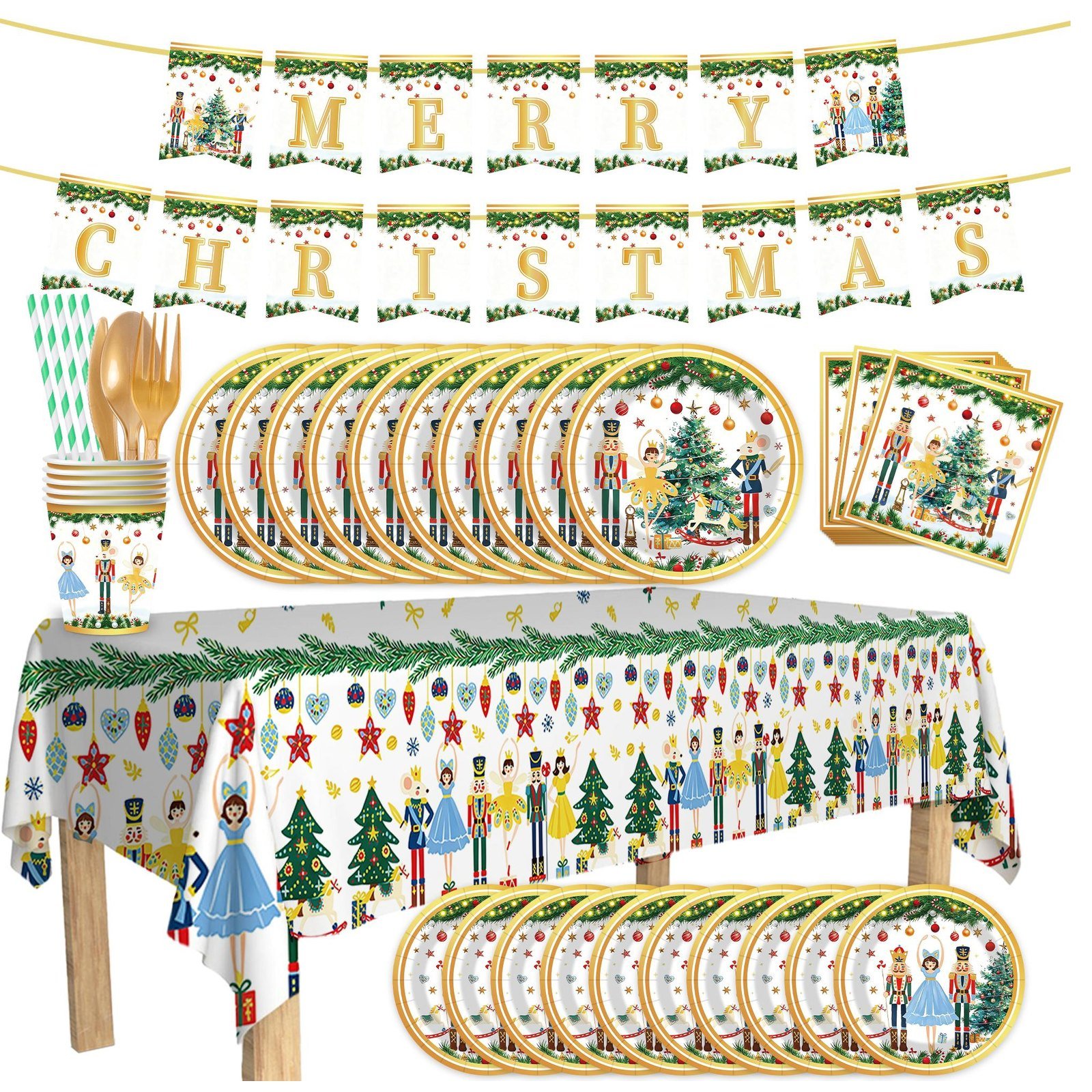
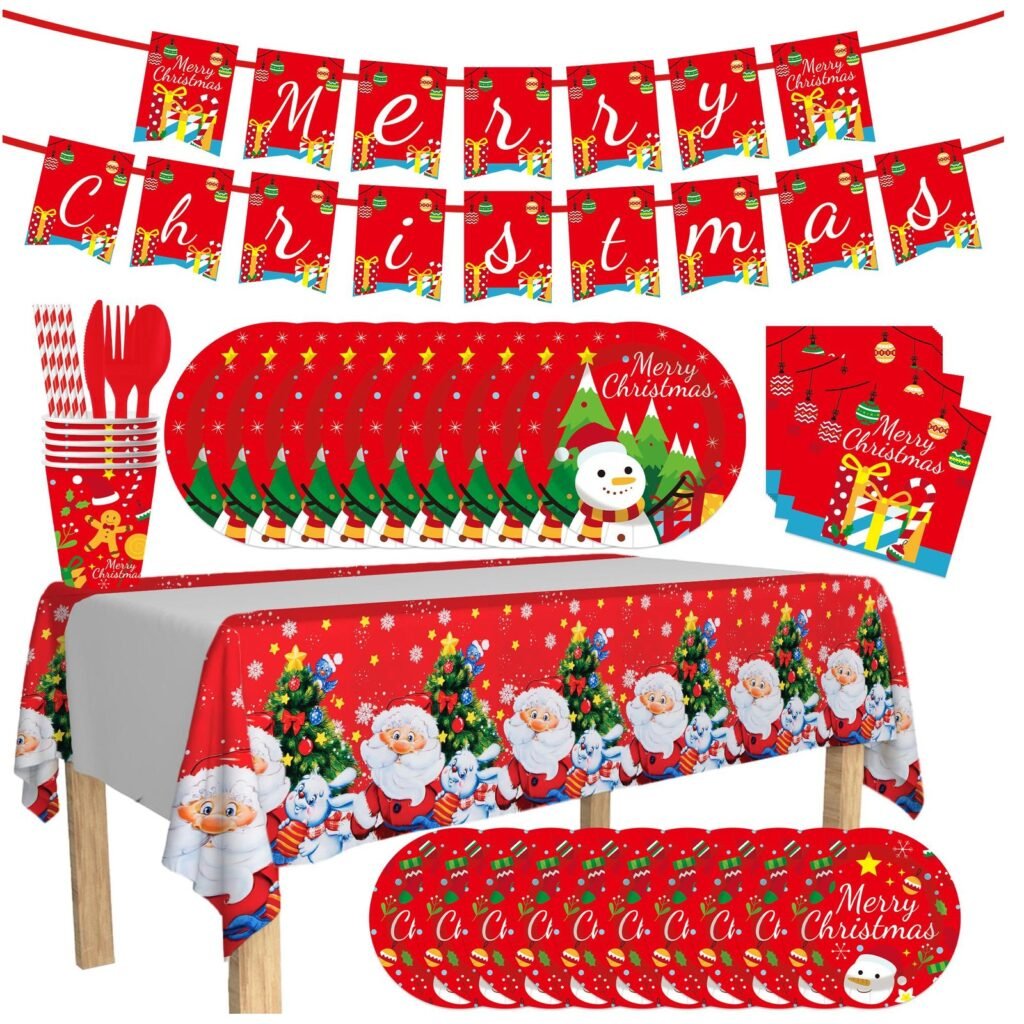
| Design | Components per set | Colour ground | Motifs | Cutlery and straws |
|---|---|---|---|---|
| DAYO-PT-047 — Red Santa and Snowman | 11 | Red | Santa, snowman, Christmas tree | Red cutlery, red-and-white straws |
| DAYO-PT-049 — Nutcracker Gold-Rim | 10 | White and green | Nutcracker, ballerina, Christmas tree | Gold-tone cutlery, gold plate rim |
| DAYO-PT-045 — Blue Santa and Elk | 11 | Blue | Santa, reindeer, snowman, gingerbread | Red cutlery, red-and-white straws |
All three use the same construction logic: paper plates, cups and napkins, plastic cutlery, paper straws and a printed table cover. The components inside a set are consistent across the range, which is what makes them comparable at all.
| Component | Stated size | PT-047 | PT-049 | PT-045 |
|---|---|---|---|---|
| Paper plate, dinner | 9in | Yes | Yes | Yes |
| Paper plate, side | 7in | Yes | Yes | Yes |
| Paper cup | 9oz | Yes | Yes | Yes |
| Paper napkin | 6.5in | Yes | Yes | Yes |
| Cutlery — knife, spoon, fork | Plastic, colour-matched | Yes | Yes | Yes |
| Paper straws | Red-and-white | Yes | Yes | Yes |
| Printed table cover | 108 × 180cm | Yes | Yes | Yes |
| Paper banner | 3m | Yes | Yes | Yes |
| Single paper banner | One piece | Yes | No | Yes |
A ten-component set and an eleven-component set are different orders
The difference between the Nutcracker Gold-Rim set and the other two is one line on that table: the single paper banner. It is a small item, and it is the reason a purchase order written against “a Christmas tableware set” without a component list can be filled with the wrong specification. If the buyer is comparing the Nutcracker design against the Red Santa and Snowman design, the two are not quoting the same contents, and a straight per-set price comparison is not measuring the same thing.
That is not a defect in either design. A ten-component set and an eleven-component set can both be correct for their intended table. What matters is that the count is stated, agreed and inspected, because the count is the one specification a buyer can verify at the carton without laboratory equipment.
Read the component list as the cost structure
Every component in these sets is packed as its own unit. That single fact explains most of the commercial behaviour of the range: the set is a bundle of independently packable items, so the cost of the order follows the component mix, not only the set count. A buyer who wants plates and napkins but does not need the table cover or the banner is not obliged to take the full set — the components can be ordered as a complete place-setting programme or split across plates, cups and napkins.
This is where a specification conversation becomes a commercial one. The useful question is not “what is the price of the set”, but “what is the price of the component mix we actually intend to sell, packed the way we intend to sell it”. A retailer selling single-occasion table settings and a distributor filling mixed cartons for several customers are buying different things from the same catalogue page.
Confirm the count on the packing specification, not on the product title
Product titles are written for search, and they are a reliable guide to the design rather than a legal description of contents. The component count belongs on the specification sheet and on the purchase order, itemised, with the count per set stated next to each line. When the count is only implied by the title, the first place the discrepancy appears is at inspection, which is the most expensive place to find it.
A practical test before ordering: ask for the component list as a numbered list with quantities per set, and check that the total equals the set count that was quoted. If the list totals ten and the quote describes eleven, the quote is not yet a specification.
Component Specifications: Plate, Cup, Napkin and Cover Sizes
Dimensions are the second half of the specification, and they are the part most often summarised rather than stated. In this range the sizes are consistent across all three designs, which makes them a useful fixed reference point for a buyer comparing suppliers or planning a mixed order.
| Item | Stated dimension | What the figure controls |
|---|---|---|
| Dinner plate | 9in | Main course presentation, place-setting footprint, carton size |
| Side plate | 7in | Dessert or bread service, stacking height in the pack |
| Cup | 9oz | Drink service, sleeve or carton count per layer |
| Napkin | 6.5in | Place-setting proportion, fold and dispense format |
| Table cover | 108 × 180cm | Table coverage, folded pack size, creasing in transit |
| Paper banner | 3m | Room or buffet decoration span, pack length |
Why the 7-inch and 9-inch plates are a pair, not a duplicate
Two plate sizes in one set is a service decision, not padding. The 9in plate carries the main course and sets the visual scale of the place setting; the 7in plate handles dessert, bread or a side. Buyers sometimes ask to drop one size to reduce cost, and that request changes the product: a single-plate set is a different proposition on the table, and it will not photograph the same way. If the intention is to reduce cost, the more honest route is to order the component mix that matches the actual selling format rather than to remove a size and keep calling it the same set.
Cup volume and napkin size are service decisions
A 9oz cup is a general-purpose festive drink format. It is large enough for soft drinks and mulled drinks service, and it is the size the carton planning in this range is built around. The 6.5in napkin is a place-setting napkin rather than a lap or buffet napkin, which matters when the buyer is comparing against a competitor’s specification: a larger napkin is not automatically a better one, but it is a different product and it changes the pack count.
Table-cover size against the actual table
The 108 × 180cm cover is a rectangular format intended for a standard dining or buffet table. Two checks are worth making before the order is placed. First, whether the cover is meant to drape or to sit within the table edge, because that changes the required size. Second, how the cover is folded and packed, because a folded printed cover creases, and creasing is more visible on a dark or saturated ground than on a pale one. That last point is one reason the white-and-green Nutcracker design and the red and blue designs behave differently in transit even though the cover is the same size.
Materials as stated in the catalogue
The material description for this range is deliberately plain: paper plates, paper cups, paper napkins, plastic cutlery, paper straws and a printed paper table cover. That is the construction, and it should be the construction that appears on the specification sheet. Where material choice affects durability, handling and protection rather than appearance alone, the published guidance on food packaging materials is a reasonable starting point for the questions a buyer should be asking about substrate and finish performance[1].
Because plates, cups and napkins are food-contact articles, any statement about suitability for food contact, or about compliance with a destination market’s requirements, should be backed by documentation that the buyer can read and check — for the specific product, material and market concerned rather than taken from a general product description[2]. A supplier can provide documents; confirming that those documents apply to the order is the buyer’s step, and it is worth completing before production rather than before shipment.
How Are the Components Packed and Consolidated?
Packing is where a component list turns into a shipping document. In this range each component is packed as its own unit, which has two consequences that matter commercially: the buyer can take a complete place-setting programme, and the buyer can split the order across plates, cups and napkins when that is the format their channel sells.
Because each component is packed as its own unit, the packing specification is a list rather than a single figure. The buyer should confirm the inner pack for every component, the master carton that follows from it, and the quantity basis used for mixed-carton consolidation and container loading.
Single-unit packing versus a pre-packed set
| Packing approach | What it supports | What it requires from the buyer |
|---|---|---|
| Each component as its own unit | Full place-setting programme, or a split order across plates, cups and napkins | A stated quantity for every component, and a consolidation plan for the mixed carton |
| Pre-packed set | A single sellable unit with a fixed contents list | A locked component count and a set-level identification that inspection can verify |
Single-unit packing is the more flexible arrangement and the more demanding one. Flexibility is the reason the range can serve both a retailer who wants the complete programme and a distributor who needs extra napkins but fewer covers. The demand is that the order document has to carry a quantity line per component. When it does not, the packing team is being asked to interpret a set-level quantity, and interpretation is exactly what a specification is meant to remove.
What carton data should exist before the order is placed
- Inner-pack quantity for each component.
- Master-carton quantity and the component mix inside it.
- Carton dimensions and gross weight.
- How the printed table cover is folded and protected against creasing.
- How the paper banner is packed so the 3m length is not deformed.
- Carton marking and component identification, so a mixed carton can be received without opening every case.
None of these figures can be assumed from a photograph, and none of them should be inferred from a previous order at a different quantity. Mixed-carton consolidation and container loading in this range are quoted against the order quantity, which means the carton plan is a function of the order rather than a fixed catalogue value. A buyer comparing two quotations should therefore compare them at the same quantity and the same component split; otherwise the loading figure in one quote describes a different shipment from the other.
Consolidation changes the shipping plan, not the verification work
Consolidating several approved items into one shipment simplifies coordination, and it does not reduce the number of things that need checking. Each component still has its own quantity, its own pack, its own marking and its own place in the inspection. The practical risk in a consolidated order is arithmetic: a mixed carton that is correct in total but wrong in mix will pass a total-count check and fail at the customer. That is why the component-level quantity belongs on the order and on the inspection record, not only on the packing list.
What Should a Purchase Order Confirm Before Production?
A purchase order for a seasonal tableware set is a specification document that happens to carry a price. If it carries the price and not the specification, the supplier is entitled to build to the description they were given, and the buyer has no reference to measure against. The fields below are the minimum worth locking down before production begins.
| Field | What it must state | Why it belongs on the order |
|---|---|---|
| Design reference | Design name and colour ground | Separates the three ranges unambiguously |
| Component list | Every component, with quantity per set | Prevents a ten-component and an eleven-component order being confused |
| Dimensions | Plate, cup, napkin, cover and banner sizes | Makes the order measurable at inspection |
| Material | Paper, plastic cutlery, paper straws, printed cover | Stops substitution on the least visible line |
| Artwork version | The approved file, identified by version or date | Removes ambiguity about which print is current |
| Reference sample | The sample inspection will be measured against | Converts “looks right” into a comparable standard |
| Quantity basis | Per component, and the consolidation unit | Carton and loading data are quoted against quantity |
| Documentation | Which documents are required, for which product and market | Keeps food-contact and market requirements explicit |
Lock the component count and dimensions on the order
The two fields that cause the most expensive corrections are the component count and the dimensions, because both are structural. A missing single paper banner is not a printing problem, it is a contents problem, and it can only be fixed by adding an item to the production plan. A plate size that drifts by an inch changes the carton, the pallet and the freight. Both are cheap to state in writing at order stage and expensive to discover at inspection.
A useful discipline is to write the component list as a numbered table on the order itself, with the per-set quantity in a column, and to have the supplier confirm the total against the set count. That single check catches the most common contents error before it becomes a production instruction.
Attach the reference sample and the artwork version
Inspection needs a standard, and the standard has to be something both parties hold. The approved reference sample serves that purpose for print, colour and finish; the artwork version serves it for the design file that produced the print. Without a retained sample, the inspection conversation degrades into a comparison against a marketing photograph, which is rendered on a screen at an unknown colour setting and is not a production standard.
The practical arrangement is straightforward: one physical sample retained by each party, marked with the approval date, and the artwork file identified by version. When a repeat season is ordered, the retained sample is the only reliable statement of what was actually approved last time.
State the quantity basis for consolidation and loading
Consolidation and container loading are quoted against order quantity, so the order has to state the quantity in the unit that the quote was built on. If the quotation was prepared on a per-component split, the order should repeat that split rather than a total set count. Where the split changes after quotation, the loading figure should be re-quoted rather than adjusted by proportion, because the carton plan is a discrete arrangement and does not scale smoothly.
What Pre-Shipment Quality Checks Apply to Paper Tableware Sets?
Pre-shipment inspection for this kind of range is mostly measurement and comparison, and very little of it requires a laboratory. The checks below are the ones that correspond to the specifications already described, which is the point: an inspection should test the order document, not a generic checklist.

| Check | Method | What it catches |
|---|---|---|
| Component count per set | Physical count against the numbered component list | Missing or substituted items, especially the banner difference between designs |
| Quantity per inner pack | Count and weigh a sample of packs | Short packs that pass a carton total check |
| Dimensions | Measure plates, cups, napkins, cover and banner | Size drift against the stated specification |
| Print and colour | Side-by-side comparison against the retained reference sample | Colour shift between production runs and between components |
| Motif and artwork version | Visual check against the approved artwork | Wrong version printed, or a mixed run |
| Cutlery colour match | Compare cutlery against the set’s colour direction | Red or gold-tone cutlery that does not match the design it ships with |
| Surface and finish | Inspect a sample for scuffing, rub marks and edge damage | Transit damage, particularly on saturated grounds and metallic finishes |
| Cover folding and creasing | Unfold a sample cover and inspect the fold lines | Creasing that will not relax before the retail display |
| Carton marking and mix | Check marking against the order, open a mixed carton | A carton correct in total but wrong in component mix |
Inspect against an approved reference, not against a marketing photo
Every visual line in that table depends on having a reference. Colour comparison against a screen photograph is not a check, because the photograph was produced under studio lighting and is displayed on an uncalibrated monitor. The comparison that means something is a physical sample, viewed under the same light as the production item, by a person who knows which differences are acceptable and which are not. Agreeing that tolerance in advance is part of the purchase order, not part of the inspection.
Component-count verification is the highest-value check
Of everything on the list, the component count is the cheapest check and the one most likely to prevent a commercial problem. It requires no equipment, it produces an unambiguous result, and it directly tests the specification that distinguishes the designs from each other. A count that matches the numbered list on the order is a strong signal that the production instruction was read correctly; a count that does not is a signal worth stopping on.
Surface and finish defects on a gold-rim design
The Nutcracker Gold-Rim set carries two finish features the other two designs do not: a gold plate rim and gold-tone cutlery. Metallic-looking decoration is a visual effect, and the way it is produced determines how it behaves in handling and transport. Published work on decorative coating processes makes the distinction clearly — appearance and performance are separate properties, and one does not establish the other for a decorative finish[3].
For a buyer, that translates into two practical steps. Confirm what the finish actually is, rather than accepting “gold” as a description. Then inspect a production sample for rub marks and surface damage at the edges and rims, because those are the areas where a decorative finish shows handling first. Packaging that separates components and prevents rubbing matters more on this design than on the two solid-colour ranges.
What this article does not claim
Nothing here reports a test result, a certification or a measured performance figure for these products. The specifications quoted are the published product data — component counts, dimensions, materials and construction. Statements about food-contact suitability, destination-market compliance or finish durability require documentation for the specific order, and that documentation should be requested and reviewed rather than assumed from a catalogue description.
Which Details Differ Between the Three Set Designs?
Once the component list and the dimensions are fixed, the remaining specification questions are about the design, and the three ranges differ in ways that affect both the packing and the inspection.
| Detail | PT-047 Red Santa and Snowman | PT-049 Nutcracker Gold-Rim | PT-045 Blue Santa and Elk |
|---|---|---|---|
| Colour ground | Red | White and green | Blue |
| Motif set | Santa, snowman, tree | Nutcracker, ballerina, tree | Santa, reindeer, snowman, gingerbread |
| Cutlery | Red | Gold-tone | Red |
| Straws | Red-and-white | Paper straws | Red-and-white |
| Plate rim | Standard | Gold rim | Standard |
| Components | 11 | 10 | 11 |
| Intended table | Classic holiday dinner | Premium holiday table | Holiday family dinner |
Colour ground and motif set
The colour ground is the detail with the largest practical effect, because it governs how the print tolerates handling. A red or blue saturated ground shows scuffing, rub marks and fold creasing more readily than the white-and-green ground used on the Nutcracker design. That is not a quality difference between the designs; it is a difference in what a defect looks like, and it changes how much protective separation each component needs inside the carton.
The motif sets also change how a component can be substituted. Santa, snowman and tree motifs appear across the Red Santa and Snowman design and the Blue Santa and Elk design with different grounds, while the Nutcracker design uses an entirely different figure set. A buyer planning a mixed order should treat the Nutcracker design as its own visual programme rather than as a recolour of the other two, because nothing in its motif set carries across.
Cutlery colour and the gold plate rim
Cutlery colour is a small line on the specification that causes a disproportionate number of mix-ups, because cutlery is packed separately from the printed paper components. Two designs in this range use red cutlery and one uses gold-tone cutlery. In a mixed order, the carton identification for cutlery therefore has to be explicit; a cutlery pack that is correct in quantity but assigned to the wrong design will only be discovered by the end customer.
The gold rim on the Nutcracker plates adds a second consideration. It is a finish on the plate itself rather than a separate component, so it cannot be verified by counting. It has to be inspected visually against the reference sample, at the rim, which is the part of the plate most exposed in stacking and handling.
How the differences affect a mixed order
An order that combines two or three designs is normal for a distributor and is where specification discipline earns its keep. The practical requirements are a component-level quantity line for every design, carton marking that identifies the design as well as the component, and an inspection record that counts each design separately. Consolidated loading can then be planned against a known mix rather than against a set total.
Frequently Asked Questions
How many components are in a Christmas tableware set?
In this range, ten or eleven. The Red Santa and Snowman set and the Blue Santa and Elk set each contain eleven components: 9in plate, 7in plate, 9oz cup, 6.5in napkin, knife, spoon, fork, paper straws, table cover, 3m paper banner and a single paper banner. The Nutcracker Gold-Rim set contains ten of those items and does not include the single paper banner. The count should always be confirmed against the component list on the order rather than inferred from the product title.
What sizes are the plates, cups and napkins?
All three designs use the same stated dimensions: 9in and 7in paper plates, 9oz paper cups, 6.5in paper napkins, and a 108 × 180cm printed table cover, with a 3m paper banner. The consistency across the range means a buyer can compare designs on contents and finish rather than on size.
Can the components be ordered separately instead of as a full set?
Yes. Each component is packed as its own unit, so one design can be ordered as a complete place-setting programme or split across plates, cups and napkins. A split order needs a quantity line per component, because consolidation and container loading are quoted against the order quantity rather than against a fixed set count.
What should be on the purchase order before production starts?
The design reference and colour ground, the numbered component list with quantity per set, the dimensions, the material specification, the approved artwork version, the retained reference sample, the quantity basis for consolidation, and the documentation required for the destination market. The component count and the dimensions are the two fields worth double-checking, because both are structural and both are expensive to correct after production.
What is checked before shipment?
Component count per set against the numbered list, quantity per inner pack, dimensions, print and colour against the retained reference sample, motif and artwork version, cutlery colour match, surface and finish condition, table-cover folding and creasing, and carton marking including the component mix inside a mixed carton. The count and the dimension checks require no special equipment and catch the errors that are most costly to fix after delivery.
Conclusion
A Christmas tableware set is a specification before it is a design. The design is what a buyer sees first, and the specification is what determines whether the delivered carton matches what was approved. In this range the specification is short enough to write down completely: ten or eleven components depending on the design, a consistent set of dimensions across all three, each component packed as its own unit so the order can be a full programme or a split across plates, cups and napkins, and consolidation and loading quoted against the quantity actually ordered. HKDayo can support wholesale buyers with component-level product data, coordinated Christmas ranges, private-label and packaging discussion, consolidation and export-service planning. Request a quotation with your intended component split and order quantity so the packing and loading figures are prepared against the order you actually intend to place.
Sources
- Food packaging’s materials: A food safety perspective – PMC — Material and packaging studies show that substrate and finish characteristics influence durability, handling, protection and use instructions, which supports specifying materials as a production property rather than a visual one.
- Food Packaging & Other Substances that Come in Contact with Food: Information for Consumers — Guidance on food-contact articles identifies supporting documentation as relevant to demonstrating conformity, which supports requesting substantiation for a specific product rather than relying on a general description.
- PVD for Decorative Applications: A Review – PMC — Work on decorative coatings distinguishes visual appearance from performance characteristics such as abrasion behaviour and cleaning durability, which supports treating a metallic-looking finish as a separate inspection item.
Hi, I'm Danson. I work closely with our manufacturing partners to develop and deliver seasonal decorations, party supplies, and celebration products for international wholesale buyers. Here, I share practical product knowledge, customization insights, and manufacturing experience to help buyers build successful seasonal collections.
Have a wholesale project in mind? Let's talk!
Discuss Your Wholesale Project Request a Wholesale QuotePlanning a Wholesale Order from China?
Share your product requirements, quantities and destination. Let's discuss your wholesale requirements.