Custom Christmas Banner Programs: Artwork, Repeat Patterns and Setup

Custom Christmas Banner Programs are often approved from a single attractive image, but that image may not be ready for production. If artwork proportions, repeat logic, dimensions, or hanging details remain unclear, a buyer can face revisions, pattern defects, or avoidable schedule pressure. I recommend treating customization as a pre-production specification process, not only as an artwork submission.
Quick Answer
A reliable custom Christmas banner program starts with a production-ready artwork review, a visual check of the repeat pattern, and clear setup information. I recommend confirming the final dimensions, artwork proportions, file requirements, repeat preview, hanging points, installation method, approval stages, and packaging expectations with the supplier before production approval.
- Confirm whether the artwork fits the proposed banner proportions.
- Request a full repeat-pattern preview rather than reviewing one tile only.
- Share the display environment, dimensions, hanging points, and installation method.
- Agree on file requirements and revision stages before submitting final artwork.
- Approve a written specification that connects design, production, and setup.
A banner may be sold as a seasonal decoration, but a wholesale program involves more than appearance. I need to connect the visual concept with the finished size, production process, retail presentation, and buyer’s installation plan. The following framework helps importers, wholesalers, and distributors reduce ambiguity before they approve a customized Christmas banner.
Custom Christmas Banner Programs: Artwork, Repeat Patterns — What Should Buyers Confirm
A buyer can submit a high-resolution image and still leave important production questions unanswered. That uncertainty becomes more serious when the design must extend across a long banner or a complete seasonal collection. I recommend using the artwork stage to clarify both the visual concept and the production conditions.

Buyers should confirm artwork proportions, usable resolution, file requirements, color expectations, repeat-pattern continuity, final dimensions, and approval responsibilities before production begins. A supplier should review whether the submitted artwork can be adapted to the proposed banner format instead of treating visual quality alone as proof of production readiness.
A good image is not automatically a usable production file
A customer may send a product mockup, a screenshot, a compressed image, or an illustration created for online presentation.[1] Each item can communicate the design direction, but each may require different preparation before manufacturing. The visual file could have:
- An unsuitable width-to-height ratio.
- Important details too close to a future edge or seam.
- Low effective resolution after enlargement.
- Missing fonts, linked images, or editable elements.
- Transparent areas that are not intended for the final product.
- Colors that appear different on screen from the finished item.[2]
- Decorative details that become unclear at the proposed scale.
I do not treat any one file extension as universally correct. A supplier may request a particular editable or high-resolution format, but that requirement depends on the production method, artwork workflow, and internal prepress process. The buyer should ask the supplier to confirm the preferred format before final submission.
The same principle applies to dimensions. A square holiday illustration may look balanced in a catalog image, while a long horizontal banner may require rearrangement. If the buyer stretches the original design to fill the banner, characters, lettering, and ornaments can appear distorted.[3] If the buyer crops it, important visual elements may disappear.
What I include in an artwork review
| Review point | Buyer should clarify | Why it matters |
|---|---|---|
| Final size | Finished length, height, and tolerance expectations | It determines the artwork proportion and layout |
| Safe area | Which elements must remain away from edges or openings | It reduces the risk of cutting or covering key details |
| Resolution | Whether the submitted file is suitable at the intended scale | Enlargement can reduce clarity |
| Editable content | Whether text, logos, and linked elements can be adjusted | It supports controlled revisions |
| Color direction | Whether color matching or visual approximation is expected | Screen appearance does not guarantee finished appearance |
| Repeat unit | The intended width and height of one repeat | It affects continuity across the banner |
| Approval proof | Which visual or production proof the buyer will approve | It creates a clear decision point |
Artwork ownership and revision control
A custom program may include a buyer’s logo, licensed seasonal artwork, original illustrations, or supplier-developed patterns. I recommend recording who supplied each visual asset and which party has permission to use it. A supplier can review technical suitability, but that review does not establish the buyer’s copyright or licensing rights.
I also recommend naming files clearly. A practical system might include the product code, version number, date, and intended size. For example, a buyer could distinguish an initial concept from an approved file without relying on email memory. I would also keep a written record of:
How Do Custom Christmas Banner Programs Handle Repeat Patterns?
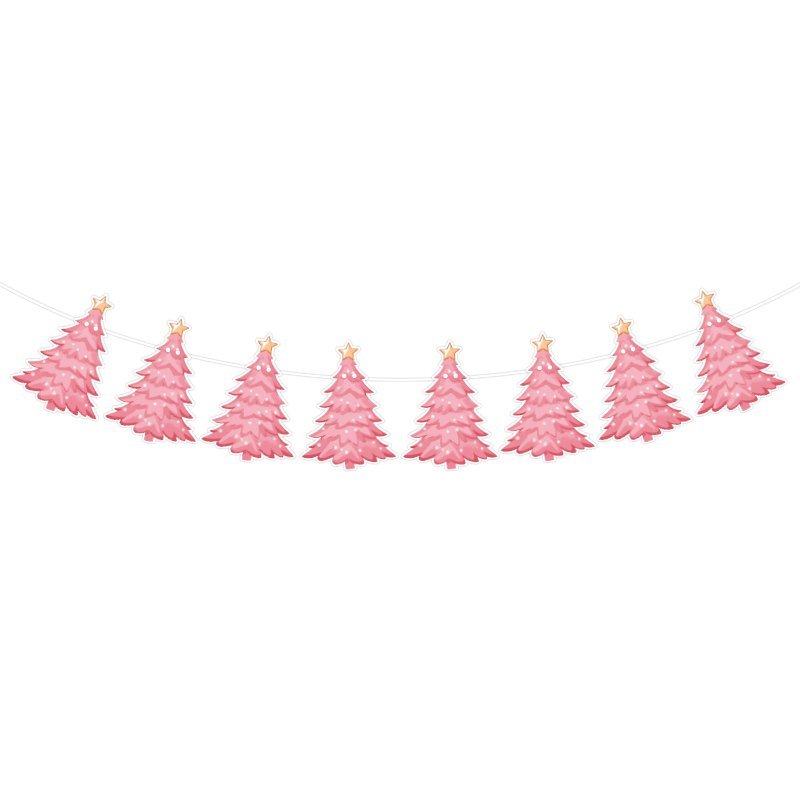
Repeat patterns need to create visual continuity across the finished banner. They are not simple copy-and-paste operations. A repeat unit can contain strong edges, large lettering, snowflakes, ornaments, or characters that become awkward when placed beside the next unit. I recommend reviewing the complete repeated composition at the intended banner proportion.
A repeat pattern works when the end of one unit connects naturally with the beginning of the next without visible seams[4], broken motifs, abrupt color changes, or unintended gaps. Buyers should request a repeat preview that shows several units together, not only a single tile.
Why one repeat tile can be misleading
A single tile may look attractive because the viewer sees only its internal composition. The problem appears when the tile is duplicated. A pine branch may stop at the right edge without continuing on the left. A line of stars may suddenly jump in height. A phrase may be cut in half. A border may create a dark vertical stripe at each join.
I recommend asking for at least three adjacent repeat units in a flat preview.[5] If the banner has a specific final length, I would also ask for a scaled layout showing how the repeat behaves across the full area. The supplier may use a different internal preview method, so the important point is not the software or file format. The important point is seeing the intended visual continuity.
Common repeat-pattern problems
- Hard vertical seams: The same dark object appears at every join.
- Broken borders: A stripe or frame changes thickness between units.
- Awkward character placement: A person, animal, or ornament is split across a boundary.
- Uneven spacing: Decorative elements cluster at one join and leave a gap at another.
- Directional mismatch: Branches, ribbons, or garlands point toward an edge and stop.
- Text interruption: Words become incomplete or repeat in an unintended position.
- Scale inconsistency: Motifs look balanced in one tile but too dense across the full banner.
- End treatment problems: The repeat works in the middle but does not suit the left and right ends.
Repeat styles buyers may consider
| Pattern approach | Visual character | Review priority |
|---|---|---|
| Straight repeat | Motifs align in regular rows or columns | Check obvious seams and vertical bands |
| Half-drop repeat | Each unit shifts by part of its height | Check diagonal flow and edge connections |
| Mirrored repeat | Adjacent units reflect each other | Check unnatural symmetry or reversed lettering |
| Randomized motif layout | Elements appear less predictable | Check density and accidental empty areas |
| Continuous scene | Artwork is designed across the full banner | Check cropping, scale, and final dimensions |
The supplier should confirm which approach is practical for the artwork and production method. I would not select a repeat style only because it sounds visually sophisticated. A simpler layout may be more commercially effective if it remains clear, scalable, and consistent across a product series.
How to write a useful repeat-pattern brief
- The desired visual mood, such as traditional, playful, minimal, or premium.
- The motifs that must appear.
- The motifs that should not touch an edge.
- Whether text may repeat.
- Whether the pattern should feel regular or varied.
- The approximate repeat direction.
- The finished banner dimensions.
- The required preview before approval.
I also recommend distinguishing a repeat preview from a final production approval. A buyer might approve the visual direction first and then approve the adjusted artwork at the final size. Those are separate decisions. A clear approval sequence reduces the chance that a preliminary mockup is mistaken for the final manufacturing file.
Why Does Setup Information Belong in a Custom Christmas Banner Program?
Setup information affects the artwork and final specification before the banner reaches the customer. A banner intended for a retail shelf, a wall, a doorway, a trade-show booth, or an outdoor seasonal display may need different proportions, edge treatment, and hanging provisions. I recommend discussing intended use at the start, not after artwork approval.
Setup information should include the display environment, finished dimensions, orientation, hanging points, installation method, visibility requirements, and packaging or labeling needs. These details can influence artwork placement, safe areas, repeat length, product construction, and the supplier’s final quotation.
The display environment changes the design brief
A banner viewed from several meters away needs a different information hierarchy from one used as a close-up photo prop.[6] Large lettering may be important in a retail or event environment. Smaller decorative details may be more suitable for online product photography or gift-store displays.
- Where the banner will be displayed.
- Whether viewers approach from one direction or several.
- Whether the banner is viewed straight on or at an angle.
- Whether it will hang above products, behind a counter, or across a wall.
- Whether the background behind it is light, dark, busy, or transparent.
- Whether the product is intended for repeated seasonal installation.
- Whether the buyer needs an individual retail package or bulk packing.
Dimensions and hanging points are connected to artwork
The finished dimensions determine more than the amount of material. They influence the visual balance of the artwork and the location of important content. Hanging points can also affect the usable design area.[7] If a corner hole, loop, tie, or channel occupies part of the edge, a logo or character placed too close to that area may be covered or visually crowded.
- Overall finished dimensions.
- Orientation: horizontal, vertical, or adjustable.
- Edge treatment and any areas that are not printable or visible.
- Location and number of hanging points.
- Whether the banner has a top and bottom direction.
- Installation hardware or accessories expected by the buyer.
- Whether the buyer wants the banner shipped flat, folded, rolled, or otherwise packed.
Setup information helps with the commercial offer
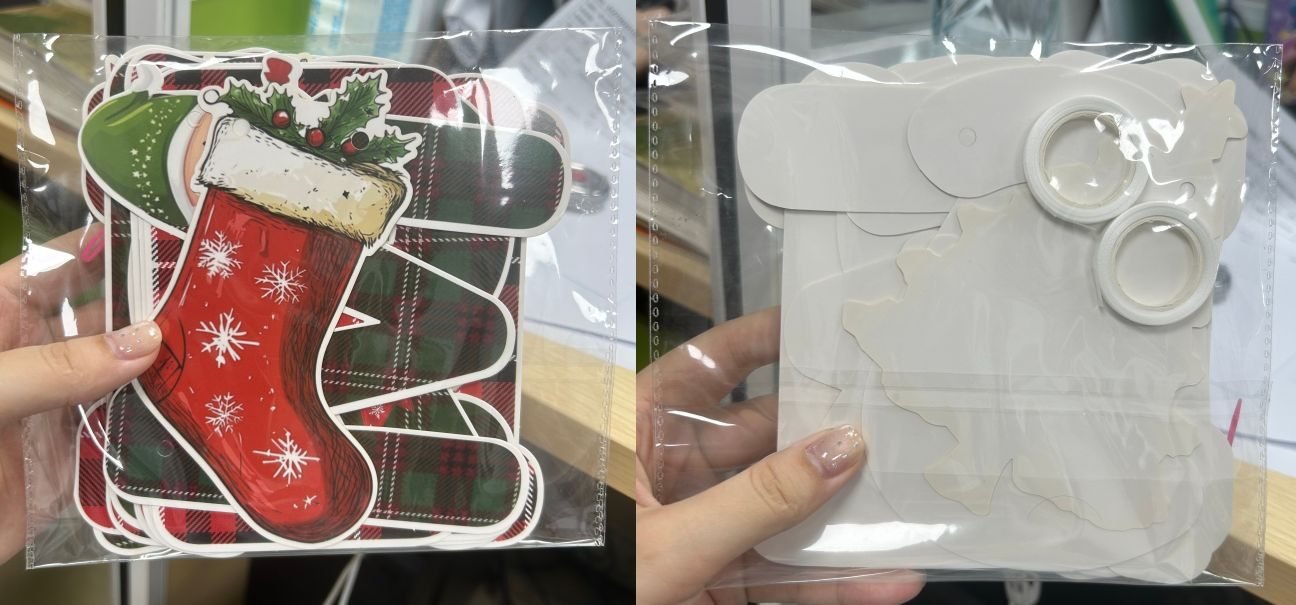
A supplier cannot evaluate a customization request accurately if the brief includes only a picture. Quantity, size, packaging, labeling, and consolidation requirements can affect the commercial proposal. If the buyer is developing a series of Christmas decorations, the buyer may also want related artwork across banners, tableware, gift packaging, or other party products.
| Information | Example of the question to ask |
|---|---|
| Use | Where will the banner be displayed? |
| Size | What finished dimensions should the supplier quote? |
| Artwork | Will the design cover the full area or use a repeat? |
| Hanging | What points or installation features are required? |
| Packaging | Is individual retail packaging needed? |
| Labeling | Are barcode, warning, origin, or private-label details required? |
| Collection | Should the banner match other seasonal products? |
| Delivery | Does the buyer need consolidation with other products? |
Which Approval Workflow Reduces Rework in Custom Christmas Banner Programs?
The safest workflow is a staged approval process. Buyers face avoidable risk when they send artwork and authorize production in the same step. I recommend separating concept approval, technical clarification, repeat review, final proof approval, and production authorization.
A practical approval workflow moves from design intent to production specification. It should include an artwork review, a dimensional and setup review, a repeat-pattern preview when applicable, a final proof, and written approval that identifies the exact version authorized for production.
Stage 1: Define the commercial and use requirements
- Product name or internal code.
- Intended sales channel.
- Seasonal collection or theme.
- Target display environment.
- Required size range.
- Estimated assortment or colorway structure.
- Packaging and labeling direction.
- Expected shipment grouping or consolidation needs.
Stage 2: Submit the concept and source files
A concept file should not be treated as a production approval. The supplier may need to confirm whether the artwork can be adapted to the proposed size or repeat. The buyer should allow room for those questions instead of assuming that a mockup represents the final file.
Stage 4: Approve a repeat preview and final proof
If the banner uses a repeat, the buyer should review the pattern across several units. If it uses a full-width scene, the buyer should review the complete composition at the intended dimensions. The final proof should identify the product size, artwork version, and any construction or packaging details that form part of the approval.
Stage 5: Freeze the specification
After approval, later changes may affect cost, schedule, or feasibility.[8] I recommend treating changes as a new review rather than silently replacing files. The buyer and supplier can then decide whether the change is minor, requires a revised proof, or affects the quotation.
A practical pre-submission checklist
- Is the finished banner size written down?
- Has the supplier confirmed the artwork requirements?
- Has the supplier reviewed the artwork proportion and resolution?
- Is the repeat preview approved, if a repeat is used?
- Are the design safe areas understood?
- Are the hanging points and installation expectations clear?
- Is the final file version identifiable?
- Are packaging and labeling requirements documented?
- Does the final proof show the actual product configuration?
- Has the authorized buyer approved production in writing?
How Should Buyers Compare Suppliers for Custom Christmas Banner Programs?
Supplier selection should include customization communication, not only unit price. A low quotation may become less attractive if the supplier cannot explain how it will review artwork, confirm repeats, document revisions, or coordinate packaging. I recommend comparing the supplier’s process as carefully as the proposed product.
Buyers should compare suppliers on artwork clarification, proofing discipline, repeat-pattern review, response quality, customization scope, packaging coordination, and export communication. Price matters, but a clear pre-production process can be equally important for seasonal purchasing.
Questions I would ask a potential supplier
- What artwork information do you need before quoting?
- Can you review a design for the proposed dimensions?
- How do you show a repeat pattern before approval?
- What information do you need about hanging or installation?
- Which parts of the quotation depend on size, packaging, or customization?
- How are artwork revisions recorded?
- What does the final proof include?
- Can you coordinate a collection of related seasonal products?
- Can you support private-label packaging or product consolidation?
- Which details must the buyer confirm with a qualified technical or installation professional?
A simple supplier comparison table
| Evaluation area | Weaker buying signal | Stronger buying signal |
|---|---|---|
| Artwork review | “The image looks fine” | Clear questions about scale, proportion, and file suitability |
| Repeat handling | One tile shown only | Several units and the full layout are reviewed |
| Setup discussion | Installation left until shipping | Use, dimensions, and hanging points discussed early |
| Revision control | Files exchanged without version names | Each approval identifies the file and date |
| Quotation | Price given without assumptions | Price notes key size, packaging, and customization assumptions |
| Seasonal collection | Designs treated separately | Related patterns and product groups can be coordinated |
| Communication | General replies | Specific questions and documented clarifications |
Why a broader supplier capability can help
For importers and distributors, a banner may be one part of a holiday assortment. A supplier with China supply-chain resources, AI-assisted design support, low-to-medium MOQ customization, private-label packaging, consolidation, and export coordination may help a buyer develop a more consistent seasonal collection. However, the buyer should verify each capability against the individual quotation and product specification.
I would still evaluate every product separately. A supplier’s ability to design a pattern does not automatically confirm suitability for every material or display method. Likewise, a supplier’s packaging support does not remove the buyer’s responsibility to confirm destination-market requirements and commercial labeling needs.
What Should Buyers Document Before Ordering Custom Christmas Banner Programs?
Documentation protects both sides when a seasonal product includes customization. The buyer needs enough information to compare quotations and approve the correct version. The supplier needs enough information to manufacture without guessing. I recommend creating one controlled specification rather than relying on scattered messages and image attachments.
Before ordering, buyers should document the product dimensions, artwork version, repeat treatment, display and hanging requirements, packaging, labeling, quantity assumptions, approval status, and any details that remain subject to supplier confirmation.
The minimum specification record
- Buyer or project reference.
- Product name and internal SKU.
- Finished dimensions and orientation.
- Artwork file name and version.
- Repeat or full-width artwork instruction.
- Important design elements and exclusions.
- Hanging-point or installation information.
- Material and construction details as quoted by the supplier.
- Packaging and carton-marking direction.
- Quantity and assortment.
- Sample or proof status.
- Production approval date.
- Open questions and responsible party.
Keep artwork, product, and packaging approvals connected
A banner may be visually approved while its retail packaging remains unresolved. That creates a risk if the package shows different dimensions, artwork, or product claims. I recommend reviewing the product image, banner artwork, packaging artwork, barcode information, and carton markings as related documents.
- Is the Christmas color palette coherent?
- Are the typography and illustration styles compatible?
- Do product names match the buyer’s catalog?
- Are different sizes clearly identified?
- Does the packaging explain the intended use accurately?
- Are similar patterns distinguished by SKU or colorway?
Conditions that require professional review
Some matters should remain subject to qualified professional or regulatory evaluation. I would recommend checking application-specific requirements when the banner will be used in a public venue, near heat sources, outdoors, in a commercial installation, or in a situation where local fire, safety, labeling, or building rules may apply.
The supplier can provide product information and manufacturing documents for buyer review. The buyer should verify whether those documents meet the destination market and intended application. I would not treat a general product statement, an unverified certificate, or a supplier claim as automatic proof of compliance.
Requesting a quotation
When the specification is ready, a buyer can submit the project through the HKDayo request-a-quote page. I recommend attaching the artwork reference, dimensions, quantity assumptions, packaging direction, and questions about repeat patterns. A supplier can respond more accurately when the request explains the intended use instead of showing only a decorative image.
Frequently Asked Questions
Is a high-resolution Christmas image ready for banner production?
Not necessarily. A high-resolution image may still have unsuitable proportions, missing editable elements, unclear color expectations, or important details too close to the edge. I recommend asking the supplier to confirm file suitability at the proposed finished size before treating the artwork as production-ready.
How many repeat units should a buyer review?
I recommend reviewing several adjacent units rather than one tile. Three or more units can reveal seams, broken borders, uneven spacing, and awkward motif transitions. If the banner has a specific final length, a scaled full-layout preview provides additional confidence.
Should installation details be included in the artwork brief?
Yes. Display location, orientation, dimensions, hanging points, and installation method can affect the usable artwork area and final construction. The exact solution should be confirmed with the supplier and, when necessary, a qualified professional familiar with the intended site.
Can one Christmas design be used across a complete product collection?
It can often provide a useful visual theme, but each product still requires its own size, artwork adaptation, packaging, and production review. I recommend confirming how the design will be adjusted for banners, tableware, gifts, or other seasonal products instead of assuming that one file can be used unchanged.
What should a buyer approve before production?
The buyer should approve the product dimensions, artwork version, repeat or full-width layout, hanging and setup requirements, packaging information, and any agreed construction details. The approval should identify the exact file or proof so that later revisions do not create uncertainty.
Conclusion
Custom Christmas Banner Programs work best when buyers treat artwork, repeat patterns, and setup as one connected specification. I recommend confirming the artwork proportion and file requirements, reviewing several repeat units, documenting the display environment, and using staged written approvals before production. Buyers should also compare suppliers on communication and revision control, not only price. If you are planning a coordinated seasonal assortment, submit your artwork, dimensions, packaging needs, and quotation questions to HKDayo for a structured review.
Sources
- Artwork Specifications | Document Solutions", A prepress reference explains that digital artwork commonly requires technical checks and preparation before it can be used reliably in print production, particularly when source elements or production specifications are incomplete
- IC Color Management – Imaging Center – Campus Offices", Color-management literature describes display and print reproduction as dependent on device characteristics, color spaces, and profiling, which can produce differences between on-screen previews and physical output
- Most apparent distortion: full-reference image quality …", An image-processing reference states that independent horizontal and vertical scaling changes an image’s aspect ratio, thereby distorting the geometry of objects and text within the image
- DigitalCommons@University of Nebraska – Lincoln Abstracts", References on seamless patterning and tiled textures define a continuous repeat by the compatibility of adjoining unit boundaries, so that replication does not introduce a visible break at the join
- Choices and Constraints: Pattern Formation in Oriental Carpets", Pattern-design and texture-evaluation literature indicates that viewing repeated units together can expose periodic boundary artifacts and spacing problems that are not visible when a single unit is inspected in isolation
- Estimating the legibility of a single letter E viewed at …", Human-factors and signage guidance relates readable detail to viewing distance and visual angle, supporting the distinction between graphics intended for distant observation and those intended for close viewing
- Exterior Banner Line – Carolina Union", Signage-production guidance notes that hems, grommets, sleeves, and other finishing features require edge clearances and can reduce or interrupt the visible artwork area
- Sample Risk List (as of September 2023)", Research on engineering change management shows that changes introduced after downstream work has begun can create additional coordination, cost, scheduling, and feasibility effects
Hi, I'm Danson. I work closely with our manufacturing partners to develop and deliver seasonal decorations, party supplies, and celebration products for international wholesale buyers. Here, I share practical product knowledge, customization insights, and manufacturing experience to help buyers build successful seasonal collections.
Have a wholesale project in mind? Let's talk!
Discuss Your Wholesale Project Request a Wholesale QuotePlanning a Wholesale Order from China?
Share your product requirements, quantities and destination. Let's discuss your wholesale requirements.