Event Bunting, Banners and Hanging Decorations: A Wholesale Specification Guide


Event bunting, banners and hanging decorations can make a seasonal display more visible, but poor specifications can create problems with installation, packaging, transport and resale. Buyers who compare unit prices first may receive products that look acceptable in a sample yet do not suit the venue, viewing distance or intended market. A scenario-based specification reduces that risk.
For wholesale event bunting, banners and hanging decorations, buyers should define the display location, viewing distance, indoor or outdoor use, material, finished dimensions, printing, attachment method, packaging and compliance requirements before requesting prices. The most suitable specification depends on the event environment and installation plan[1], so buyers should compare complete product solutions rather than unit cost alone.
Quick Answer
- Define the venue, viewing distance and installation method before choosing materials or sizes.
- Compare material, printing, finishing, spacing and hanging hardware as one connected specification.
- Treat larger dimensions and denser decoration as trade-offs involving visibility, weight, packaging and freight.
- Request samples that represent the final artwork, construction and attachment points.
- Ask suppliers to identify which claims require verification for outdoor exposure, fire performance, load capacity or destination-market regulations.
A quotation becomes much easier to compare when every supplier is responding to the same information. I recommend preparing the display scenario first, then converting that scenario into a practical inquiry sheet. The sections below explain how to do that without treating any single material or construction method as universally suitable.
Event Bunting, Banners and Hanging Decorations: What Should Buyers Specify First
A vague inquiry can produce several technically different quotations. One supplier may price a lightweight indoor banner, while another may quote a reinforced outdoor product. Both offers may appear correct, but they are not commercially comparable. The first step is to describe how the decoration will be used.

Buyers should specify the venue, display period, viewing distance, installation surface, indoor or outdoor environment, required artwork and expected reuse before discussing a final price. These details help suppliers recommend appropriate dimensions, materials, printing methods, finishing and hanging structures for the intended event.
Start with the display scenario
- Event and season: Christmas, Halloween, graduation, wedding, birthday, retail promotion or another occasion.
- Location: shop window, wall, ceiling, entrance, stage, table area, outdoor fence or temporary event structure.
- Viewing distance: close range, normal room distance or long-distance visibility across a venue.
- Display period: one day, several weeks, a full season or repeated annual use.
- Environment: indoor, sheltered outdoor or fully exposed outdoor use.
- Installation surface: wall, ceiling, cable, pole, railing, display frame or adhesive surface.
- Quantity structure: individual pieces, a coordinated string, a hanging set or a full themed collection.
- Packaging and sales plan: bulk carton, individual retail packaging, private-label packaging or e-commerce fulfillment.
For example, a small indoor party banner may need simple stringing and compact folding. A large outdoor seasonal banner may require edge finishing, stronger attachment points and packaging that protects printed surfaces from creasing. A ceiling-hanging decoration may need balanced weight distribution rather than merely a larger printed area.
Translate retail use into a wholesale product brief
| Inquiry field | Information to provide | Purchasing risk reduced |
|---|---|---|
| Finished size | Overall length, height, flag size or diameter | Incorrect visibility and shelf presentation |
| Material | Preferred material or acceptable alternatives | Unexpected hand feel, weight or price |
| Printing | Artwork, color expectations, one-sided or two-sided | Artwork mismatch and unclear sampling |
| Construction | String, header, tabs, eyelets, hooks or rings | Installation problems |
| Spacing | Distance between flags or hanging elements | Different visual density |
| Environment | Indoor, sheltered outdoor or exposed outdoor | Unsuitable durability assumptions |
| Packaging | Bulk, set pack, retail card or customized box | Repacking labor and freight variance |
| Quantity | Total units, color ratio and assortment | Incomplete quotation |
| Compliance | Destination-market documents or test requirements | Delayed approval or market restrictions |
I would not ask only, “What is your cheapest banner?” A stronger inquiry asks, “Please quote this banner for indoor retail display, with the attached artwork, the stated finished size, a defined string length and the proposed packaging.”
How Do Material and Printing Choices Affect Event Bunting, Banners and Hanging Decorations?
Material and printing decisions influence appearance, handling, cost, packed volume and intended use. A material that looks attractive in a product photograph may not fold, hang or ship in the same way as another material. Printing also needs to be considered together with color coverage, viewing distance and whether both sides are visible.
No material or printing method is best for every event decoration. Paper, fabric, synthetic sheet and other substrates may suit different indoor, outdoor, reusable or budget requirements. Buyers should request samples and product-specific evidence before making claims about durability, color stability, fire performance or weather resistance.
Compare material families by use case
| Material family | Potential advantages | Points to verify | Commonly considered for |
|---|---|---|---|
| Paper-based stock | Lightweight, printable and compact for indoor seasonal use | Moisture sensitivity, crease resistance and edge strength | Party kits, short-term indoor displays |
| Fabric or textile | Soft appearance, foldability and possible reuse | Fraying, print clarity, washing or care requirements | Bunting, backdrops and reusable décor |
| Synthetic sheet or film | Smooth surface and potential moisture resistance | Thickness, flexibility, recycling requirements and finish | Retail displays and selected outdoor applications |
| Rigid board or formed pieces | Strong visual shape and dimensional presentation | Packed volume, breakage and shipping protection | Hanging signs, themed shapes and premium displays |
| Wood, foam or composite elements | Tactile or decorative effect | Weight, edge finish, splintering and hardware | Rustic, premium or themed collections |
The correct comparison depends on the complete product. Two banners made from the same material can perform differently because of thickness, lamination, edge finishing, print coverage or attachment construction.
Printing is part of the specification
- Artwork format and final dimensions.
- Whether the design is printed on one side or both sides.
- Whether the reverse side must look finished.
- Expected color reference or approved artwork proof.
- Text legibility at the intended viewing distance.
- Whether gradients, small lettering or fine patterns are included.
- Whether the design is seasonal, private label or licensed.
I recommend approving a digital artwork proof before sampling, but I would not treat a digital proof as a substitute for a physical sample. Screen color and printed color can differ because of material, ink, surface finish and viewing light.[3]
Small text is another practical concern.[2] A design that looks clear on a computer screen may become difficult to read when individual flags are small or when the decoration is viewed across a retail space. Buyers should review artwork at the actual finished size.
Outdoor claims need evidence
Outdoor use is not a single performance category.[4] Sheltered outdoor use, occasional outdoor use and continuous exposure to rain or sunlight create different requirements. Buyers should ask suppliers to identify the exact product, test method and conditions behind any claim about:
I would request supporting documents where the destination market or venue requires them. Certifications and test reports should be checked for the correct product, material, construction and production source. A document for one substrate should not automatically be applied to an unrelated decoration.[5]
How Should Buyers Balance Size, Spacing and Hanging Structure?
Size improves visibility only when the decoration can be installed safely, packed efficiently and displayed in the available space. A long string of closely spaced flags may create a fuller appearance, but it can also increase material use, packed length and installation time. A large hanging shape may attract attention while creating more surface area for bending or damage.
Buyers should choose dimensions and spacing according to viewing distance, available display area, installation height and transport limits. They should compare the complete hanging structure, including string, header, tabs, eyelets, hooks, rings and reinforcement, rather than evaluating printed size alone.
Connect dimensions to visibility
- Overall string length.
- Number of flags or hanging elements.
- Finished width and height of each element.
- Distance between elements.
- Margin at each end.
- Distance from the hanging point to the printed area.
- Folded or packed dimensions.
A buyer may request a “two-meter banner,” but that phrase can mean the total string length, the printed section or the carton dimension. I recommend using a simple drawing with arrows and labels. The drawing should show the total length, element dimensions, spacing and attachment points.
Consider installation before increasing size
- How many people are expected to install it?
- Will the installer use a ladder or lifting equipment?
- Is the surface smooth, porous, painted or temporary?
- Will adhesive, hooks, cable ties, clips or cord be used?
- Can the venue support the proposed attachment method?
- Does the decoration need to be removed without damaging the surface?
- Will the product be reused or discarded after the event?
I do not recommend assuming that included hardware is suitable for every venue. A hook, clip or cord may work for a lightweight indoor product but may not meet the requirements of a heavier hanging display. Load capacity and structural suitability require product-specific and, where relevant, qualified professional evaluation.[6]
Understand density and spacing
| Structure | Visual effect | Commercial consideration |
|---|---|---|
| Widely spaced flags | Light, open and economical appearance | Lower material use but less visual coverage |
| Medium spacing | Balanced coverage for many indoor displays | Moderate packed length and installation effort |
| Closely spaced flags | Fuller and more colorful appearance | Higher material use and potentially longer setup |
| Layered hanging pieces | Greater depth and movement | More components, attachment points and packing care |
| Single large panel | Strong graphic impact | More sensitivity to creasing, weight and support |
A supplier may quote by piece, set, meter or carton. These pricing units are not interchangeable. The inquiry should define the number of flags per string, total string length and whether replacement pieces are included.
Hardware should be specified clearly
Each option changes the look and the installation method. It can also change packing requirements. For example, rigid rods may create a longer carton than folded fabric. Metal hardware may add weight and require protection against scratching. Small loose components may create counting and packing risks.
Which Finishing and Packaging Details Matter for Wholesale Orders?
Finishing and packaging often determine whether a product reaches the buyer ready for sale or requires additional labor. A low unit price can become less attractive when the buyer must trim threads, sort mixed sets, replace damaged pieces or repackage each unit.
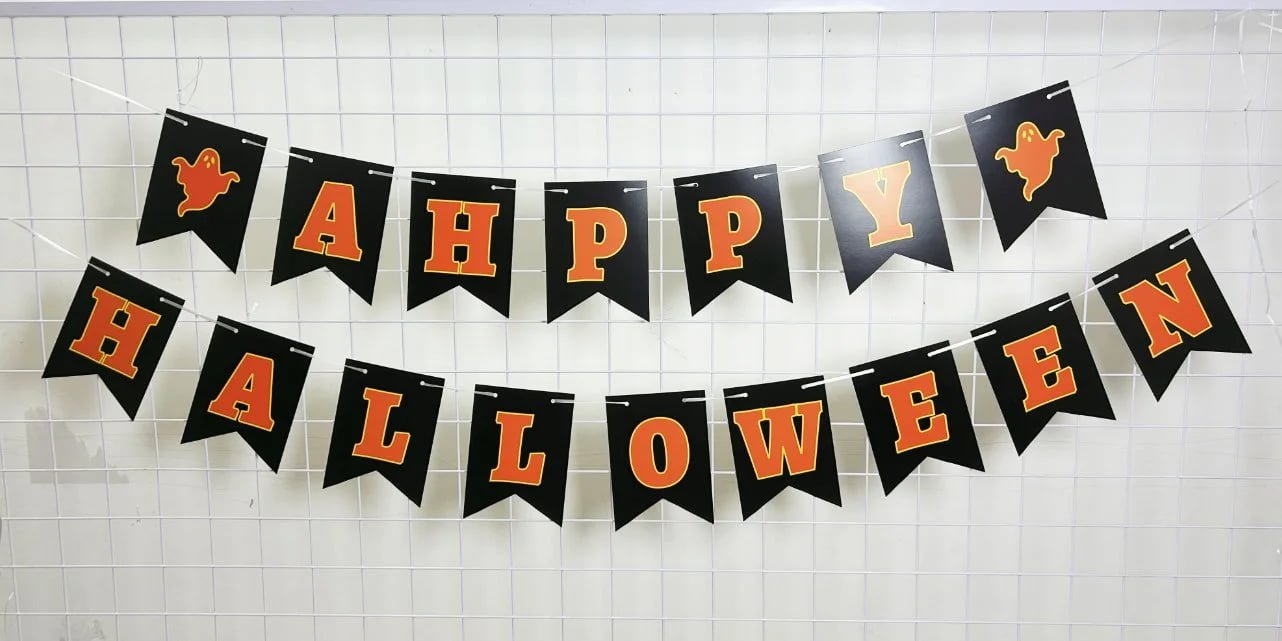
Wholesale buyers should specify edge finishing, reinforcement, assembly, set composition, counting method, individual packaging, carton protection and shipping marks. Packaging should protect the decoration while controlling volume, labor and damage risk.
Review finishing as a functional detail
- Hemmed fabric edges.
- Heat-sealed synthetic edges.
- Folded paper edges.
- Reinforced corners.
- Eyelets or punched holes.
- Sewn tabs.
- Attached cord.
- Pre-assembled strings.
- Separate components for buyer assembly.
The right choice depends on the substrate and intended use. A finished edge may improve handling, but it can also add labor and cost. A punched hole may be adequate for a lightweight indoor paper decoration, while a heavier or repeatedly used item may require a different attachment design.
I recommend requesting close-up images or a physical sample of corners, holes and attachment points. These small areas often reveal more about production consistency than a front-facing product photograph.
Packaging affects logistics
- Unit packaging: How one retail unit is protected and presented.
- Inner packaging: How several units are grouped for counting and handling.
- Master carton: How the shipment is protected and labeled.
Buyers should confirm whether products are folded, rolled, stacked or loosely packed. Folding can reduce volume but may create creases.[7] Rolling may protect certain printed surfaces but can increase carton dimensions. Rigid inserts can reduce bending while increasing material use and freight volume.
| Packaging format | Advantages | Risks to review |
|---|---|---|
| Bulk carton | Lower packaging cost and simple consolidation | More buyer-side sorting or repacking |
| Polybag set pack | Easy counting and basic product protection | Plastic requirements and limited premium presentation |
| Card or header packaging | Useful for retail hanging display | Higher assembly labor and possible bending |
| Printed box | Strong private-label presentation | Greater tooling, printing and volume considerations |
| Protective sleeve or insert | Better surface protection | Added material and packed dimensions |
Packaging is especially important for e-commerce sellers. The retail package should be assessed for dimensional weight[8], shelf presentation, barcode placement and protection during parcel delivery. A product that ships well in a master carton may still need additional protection for individual orders.
Confirm set composition
The quotation should state the contents, quantity per set, color ratio, accessories and replacement policy if applicable. It should also state whether artwork is applied consistently across all pieces.
Plan for consolidation
- SKU or buyer reference.
- Product description.
- Quantity per carton.
- Carton number.
- Net and gross weight.
- Carton dimensions.
- Country-of-origin marking where required.
- Special handling notes.
How Can Buyers Compare Wholesale Quotations Fairly?
A quotation is useful only when the quoted products are equivalent. Different assumptions about material, size, printing, packaging or accessories can make one supplier appear cheaper without offering the same commercial solution.
Buyers should compare a specification-matched quotation that separates product price, customization, tooling, packaging, sampling, shipping assumptions and compliance-related costs. They should also assess installation effort, packed volume, quality controls and suitability for resale instead of choosing the lowest unit price automatically.
Build a quotation comparison sheet
| Comparison item | Supplier A | Supplier B | Supplier C |
|---|---|---|---|
| Material and thickness | |||
| Finished size | |||
| Number of pieces per set | |||
| Total string length | |||
| Printing side and method | |||
| Edge and hole finishing | |||
| Hardware included | |||
| Unit and set price | |||
| Packaging format | |||
| Carton dimensions | |||
| Sample and tooling charges | |||
| Production assumptions | |||
| Required documents | |||
| Shipping basis |
Evaluate total landed suitability
- Sampling and artwork preparation.
- Packaging customization.
- Inspection or testing.
- Inland transport.
- Export documentation.
- International freight.
- Duties and taxes.
- Warehouse handling.
- Repacking or relabeling.
- Installation labor.
- Expected waste or replacement pieces.
The buyer may not be able to calculate every cost at the inquiry stage. However, asking for carton dimensions and packed weight helps the logistics team estimate freight exposure. Asking for assembly details helps the operations team estimate labor.
Use samples as decision tools
- Finished dimensions against the approved drawing.
- Color and artwork position.
- Edge quality and corner alignment.
- Hole position and attachment strength.
- String length and spacing.
- Fold lines and surface marks.
- Accessory count.
- Retail packaging quality.
- Carton protection.
- Ease of installation.
Add quality-control checkpoints
- Artwork approval: Confirm dimensions, text, colors and print direction.
- Pre-production sample: Confirm construction and packaging concept.
- During production: Check material, printing and assembly consistency.
- Pre-shipment inspection: Check quantity, dimensions, appearance, accessories and cartons.
- Loading review: Check carton condition and shipping marks.
Sampling and inspection methods should match the product’s commercial risk. A simple party banner may need a different inspection depth from a coordinated retail collection with private-label packaging.
How Should Buyers Prepare an Inquiry for Custom Event Decorations?
Custom products often fail commercially because the inquiry describes the visual idea but not the physical product. A supplier may understand the theme while still lacking the information needed to quote or manufacture consistently.
A strong custom-decorations inquiry combines artwork, dimensions, materials, construction, packaging, quantity, destination and timing. Buyers should identify which details are fixed and which alternatives suppliers may propose, then approve a complete specification before production.
Separate fixed requirements from flexible options
- Alternative substrates.
- Different cord or ribbon.
- Several finishing methods.
- Supplier-proposed carton configuration.
- Alternative hardware for indoor display.
- A choice between pre-assembled and flat-packed sets.
Include destination and market information
The supplier needs to know where the goods will be sold and, where relevant, where they will be displayed. Requirements can differ by destination, venue and product construction. Buyers should identify any known requirements concerning:
I recommend treating certifications, declarations and test reports as documents to verify, not as general assurances. The buyer should confirm that the document applies to the exact product, material, factory and destination-market requirement. Qualified compliance professionals should review application-specific questions.
Use a specification checklist before requesting price
- Product reference or inspiration image.
- Artwork or design direction.
- Finished dimensions.
- Material preference and acceptable alternatives.
- Printing requirements.
- Construction and attachment method.
- Indoor or outdoor environment.
- Estimated quantity and assortment.
- Packaging requirements.
- Sample expectations.
- Target delivery window.
- Destination port or warehouse.
- Required documentation.
- Inspection expectations.
What Should Buyers Verify Before Approving Production?
Before production approval, buyers should verify the physical sample, artwork, construction, dimensions, set contents, packaging, carton information and any required documents. They should record approved versions clearly and request professional evaluation where safety, load, fire or regulatory questions remain.

Review the approval record
- Product name and SKU.
- Version number or date.
- Approved artwork file.
- Material and construction.
- Finished dimensions and tolerances.
- Packaging reference.
- Accessories and quantity.
- Inspection requirements.
- Buyer and supplier approval status.
Check the collection as a system
- Consistent color appearance.
- Similar pattern scale.
- Compatible packaging.
- Balanced price points.
- Shared materials where appropriate.
- Complementary sizes.
- Practical shelf and carton presentation.
- Clear differences between related SKUs.
A collection can be visually attractive but operationally difficult if every item requires a different packaging process or unusual hardware. The buyer should balance creative differentiation with repeatable production and manageable inventory.
Prepare for seasonal timing
The exact schedule depends on product complexity, order quantity, customization and shipping method. I recommend confirming a realistic schedule with the selected supplier instead of relying on a generic lead-time promise.
Frequently Asked Questions
What is the best material for wholesale event bunting?
There is no single best material. Paper may suit short-term indoor party products, while fabric, synthetic sheet or rigid components may suit other display, reuse or presentation requirements. Buyers should match the material to the environment, viewing distance, packed volume, budget and intended product life.
Should event banners be printed on one side or both sides?
One-sided printing may be sufficient when the banner is placed against a wall or viewed mainly from one direction. Two-sided printing may be useful when people can walk around the decoration. Buyers should consider artwork direction, reverse-side appearance, material opacity and the effect on cost and weight.
How do I specify the size of a bunting string?
State the total finished string length, number of flags, individual flag dimensions, spacing, end margins and attachment method. A simple drawing is helpful. Buyers should also clarify whether the quoted size includes the cord beyond the first and last flag.
Can I use the same event decoration indoors and outdoors?
A product designed for indoor use should not automatically be marketed for outdoor use. Buyers should ask for product-specific evidence concerning moisture, sunlight, wind, temperature and attachment requirements. Any fire, load or regulatory question should be checked for the destination market and intended venue.
What should I request in a supplier sample?
Request a sample that represents the proposed material, artwork, dimensions, construction, attachment points and packaging. Check the actual set contents, spacing, finish, folded condition and installation method. If the sample uses substitute materials, ask the supplier to identify every difference before approval.
Conclusion
Event bunting, banners and hanging decorations should be specified as complete display systems, not as isolated printed pieces. I recommend starting with the venue, viewing distance, environment and installation method, then connecting material, dimensions, printing, finishing, spacing, hardware and packaging. Buyers should compare matched quotations, approve representative samples and verify any claims about outdoor durability, fire performance, load capacity or compliance. For a tailored wholesale or OEM inquiry, contact HKDayo through the request-a-quote page with your artwork, display scenario and packaging requirements.
Sources
- Smithsonian Guidelines for Accessible Exhibition Design", Research on temporary display planning supports treating location, viewing conditions and installation requirements as interdependent design inputs rather than selecting decorative products by unit price alone
- Electronic paper display preferred viewing distance and …", Human-factors studies indicate that readability is affected by character size, contrast and viewing distance, supporting review of artwork at its intended finished scale
- (PDF) Color Management in Printing Process …", Color-management guidance explains that monitor and print appearance are not directly equivalent because displays emit light while printed colors depend on substrate, inks, surface properties and viewing illumination
- Moisture Control Guidance for Building Design, …", Weathering research shows that ultraviolet radiation, moisture, temperature cycling and exposure duration can affect substrates, coatings and printed surfaces, supporting distinctions between sheltered and fully exposed outdoor use
- General Use Products: Certification and Testing", Conformity-assessment guidance generally limits the evidentiary value of a test report or certificate to the identified product, material, manufacturing conditions and applicable test scope
- 1910.305 – Wiring methods, components, and equipment …", Safety guidance for suspended objects treats load, attachment method and supporting structure as application-specific factors and recommends competent evaluation where overhead or structural hazards are involved
- Converting and its effects on barrier properties of coated …", Packaging and materials studies support the general trade-off that folding can reduce packed volume while producing permanent or visible creases depending on substrate, coating and fold geometry
- 150 Quick Service Guide – Postal Explorer – USPS", Postal and logistics guidance defines dimensional weight as a volume-based charging measure used in some parcel services, supporting review of retail-package dimensions in addition to actual mass
Hi, I'm Danson. I work closely with our manufacturing partners to develop and deliver seasonal decorations, party supplies, and celebration products for international wholesale buyers. Here, I share practical product knowledge, customization insights, and manufacturing experience to help buyers build successful seasonal collections.
Have a wholesale project in mind? Let's talk!
Discuss Your Wholesale Project Request a Wholesale QuotePlanning a Wholesale Order from China?
Share your product requirements, quantities and destination. Let's discuss your wholesale requirements.