Halloween Tableware Wholesale: Plates, Cups and Napkins Buying Guide

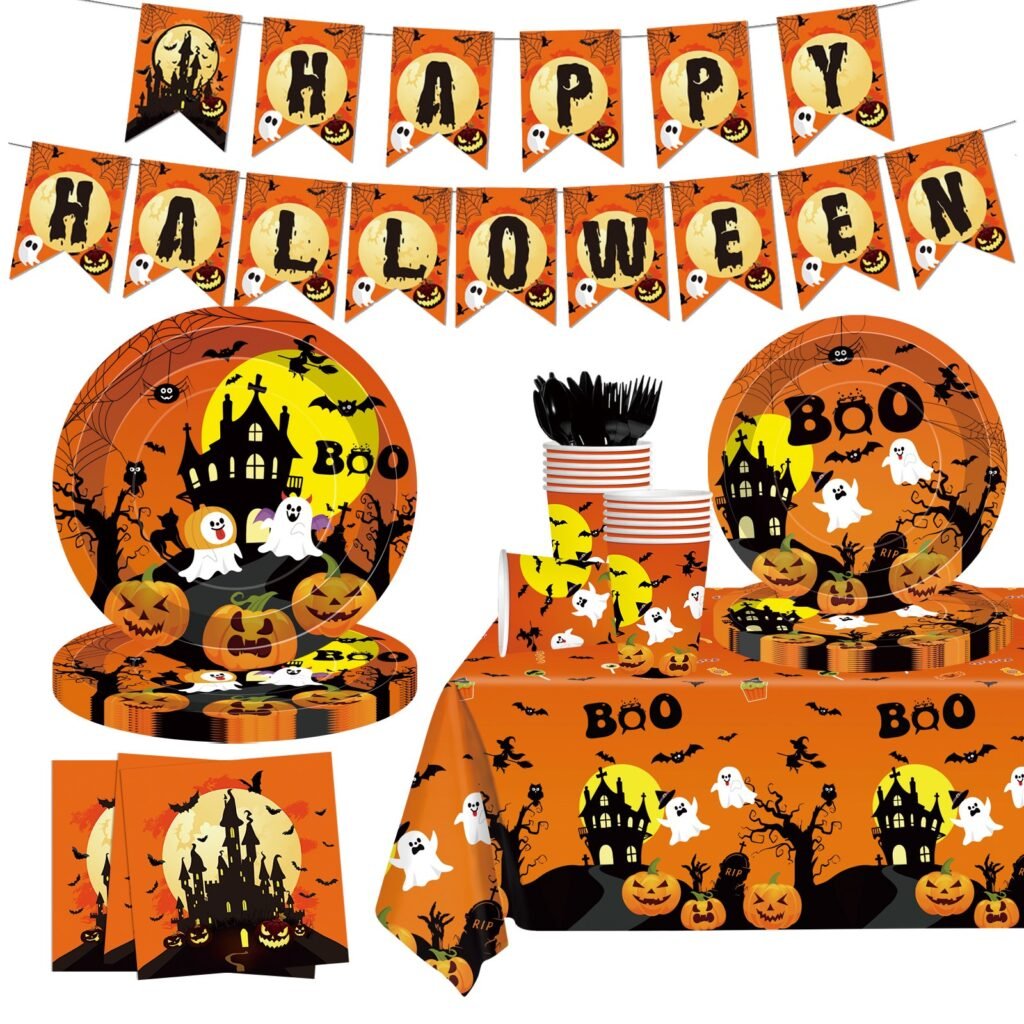
Halloween tableware wholesale planning can become difficult when a short, date-fixed selling season meets limited shelf space, changing design trends, and tight import schedules. A weak assortment can look disconnected and leave buyers with slow-moving stock. A coordinated 2027 programme helps retailers offer clear party solutions instead of isolated products.
Quick Answer
Halloween tableware wholesale works best when buyers source coordinated plates, cups, napkins, and selected decorations as one design story for Halloween 2027. Start with a focused format mix, separate kid-friendly and adult horror themes, approve written specifications rather than images alone, and confirm MOQ, delivery estimates, food-contact requirements, and freight planning for each destination before committing.
- Build collections around one icon, colour palette, and finish across all core tableware.
- Prioritise coordinated sets over too many sizes or isolated single-SKU designs.
- Plan Halloween 2027 well ahead; 2026 retail selling is imminent and is not a practical window for new bulk ocean-freight programmes.
- Request quotations with SKU interest, quantity by design, destination, required delivery window, and private-label requirements.
- Treat all production, shipping, compliance, and delivery timing as order-specific estimates until confirmed in writing.
A strong programme does more than fill a party aisle. It gives shoppers an easy visual reason to buy matching products together. The details below help wholesale buyers compare formats, designs, quality controls, customisation choices, and consolidation options before building a Halloween 2027 order.
What Halloween Tableware Covers: Plates, Cups, Napkins and Coordinated Sets
Halloween tableware wholesale often appears simple at first: plates, cups, and napkins. However, buyers can lose sales when those items do not work together visually or when the pack mix does not match the party occasion. A coordinated set makes the purchase easier for the shopper.
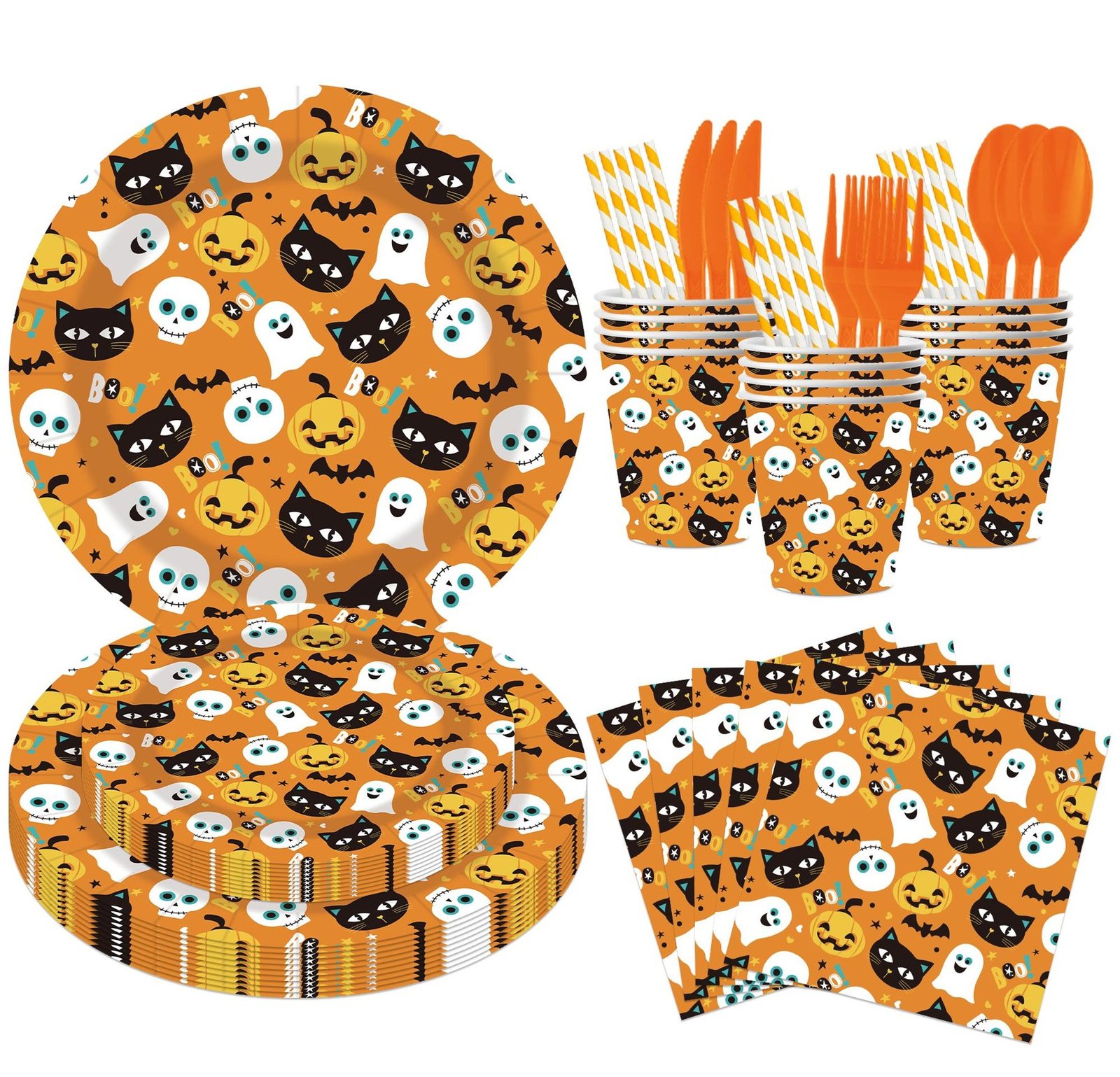
For most wholesale programmes, the core range includes paper plates, paper cups, luncheon-style napkins, beverage napkins, and optional serving or shaped formats. Buyers may also combine the collection with lightweight decorations, party accessories, and themed giftable items where the retail channel supports cross-selling.
| Product format | Typical party role | Buyer consideration |
|---|---|---|
| Plates | Meals, snacks, desserts | Match rigidity and coating to intended food use |
| Paper cups | Cold drinks and party tables | Confirm capacity and intended beverage use |
| Luncheon napkins | Main food service | Useful for family meals and buffet occasions |
| Beverage napkins | Drinks, desserts, snacks | Compact add-on item for party baskets |
| Coordinated sets | Fast party solution | Supports higher basket value and shelf impact |
A coordinated range creates a more complete offer than individual designs placed side by side. For example, a pumpkin plate, matching cup, and matching napkin can communicate a ready-made party theme in seconds. That visual clarity matters in seasonal retail, where shoppers often make fast decisions.
Buyers reviewing party tableware programs should ask whether the design can extend beyond the core formats. A design story may include table covers, banners, hanging decorations, treat bags, or party accessories, but only when those additions support the same retail audience.
The most useful selection process starts with the shopper’s party need:
- Children’s gatherings: bright icons, friendly characters, simple matching sets.
- Family events: broad appeal, familiar Halloween imagery, practical formats.
- Adult gatherings: graphic prints, dark colour schemes, horror-inspired details.
- Retail impulse purchases: visually clear packs, strong front-facing artwork, easy add-on items.
A buyer does not need every possible format to create a credible collection. In a first season, a smaller set of well-coordinated products can be easier to merchandise, replenish, and explain to retail customers than a deep range with too many near-duplicate SKUs.
Halloween 2026 Is Already Committed: Why This Guide Plans the 2027 Season
Halloween 2026 is close to 31 October 2026, so buyers should not treat the current period as a practical time for new bulk ocean-freight Halloween imports. Seasonal goods must arrive before the retail set date, not after consumers have started shopping. The relevant planning focus is Halloween 2027.
For a 2027 programme, design selection, sample review, quotation comparison, packaging approval, production booking, and freight planning should be handled well before the retail launch period. Exact timing depends on the product mix, customisation level, destination, transport method, supplier production availability, and forwarder arrangements.
| Planning stage | Halloween 2027 purpose | Status to confirm |
|---|---|---|
| Design selection | Choose theme families and core formats | Planning projection |
| Sample review | Check artwork, dimensions, materials, packs | Order-specific estimate |
| Bulk production booking | Reserve approved production slot | Supplier confirmation required |
| Freight planning | Match transport method to retail landing date | Forwarder confirmation required |
| Retail delivery | Allow time for receiving and merchandising | Buyer-controlled schedule |
A sensible buyer workflow separates commercial ambition from confirmed logistics. A team may want a broad Halloween party supplies wholesale collection, but the final assortment should reflect what can be approved, packed, shipped, received, and merchandised within the buyer’s own calendar.
It is also important to separate a planning estimate from a delivery promise. A supplier may provide an estimated production window, while a freight forwarder may provide an estimated transit window. Neither should be treated as a final commercial commitment until the relevant booking, documentation, and shipment details are confirmed.
The following questions can keep the 2027 calendar realistic:
- When must retail stores, warehouses, or online fulfilment centres receive the goods?
- How much time is needed for inbound checks, carton labelling, and merchandising?
- Does the programme require custom artwork, private-label packaging, or shaped tooling?
- Will the shipment travel with other seasonal products?
- Which party needs to confirm each stage: buyer, supplier, packaging provider, or forwarder?
This approach reduces the risk of approving attractive designs too late to support a practical landing plan. It also makes it easier to compare quotations fairly because each supplier receives the same commercial brief.
Design Directions That Sell: Pumpkin, Ghost, Clown and Adult Horror Themes
A Halloween range can lose impact when it mixes cute, classic, and horror-led graphics without a clear structure. Shoppers usually respond more quickly when the products look like they belong together. A focused design family helps a tableware programme read as intentional rather than leftover stock.
The strongest Halloween design direction usually combines three elements: a central icon, a colour palette, and a finish. A pumpkin, ghost, bat, spider, skull, or clown can provide the recognisable icon. Orange and black, purple and lime, blood red and black, or muted adult colour schemes can establish the mood. Matte, gloss, foil-style accents, and die-cut shapes can change perceived value.
| Design family | Core visual direction | Best retail fit |
|---|---|---|
| Friendly pumpkin and ghost | Bright colours, simple faces | Kids and family parties |
| Classic Halloween | Bats, spiders, pumpkins, orange-black palette | Broad seasonal retail |
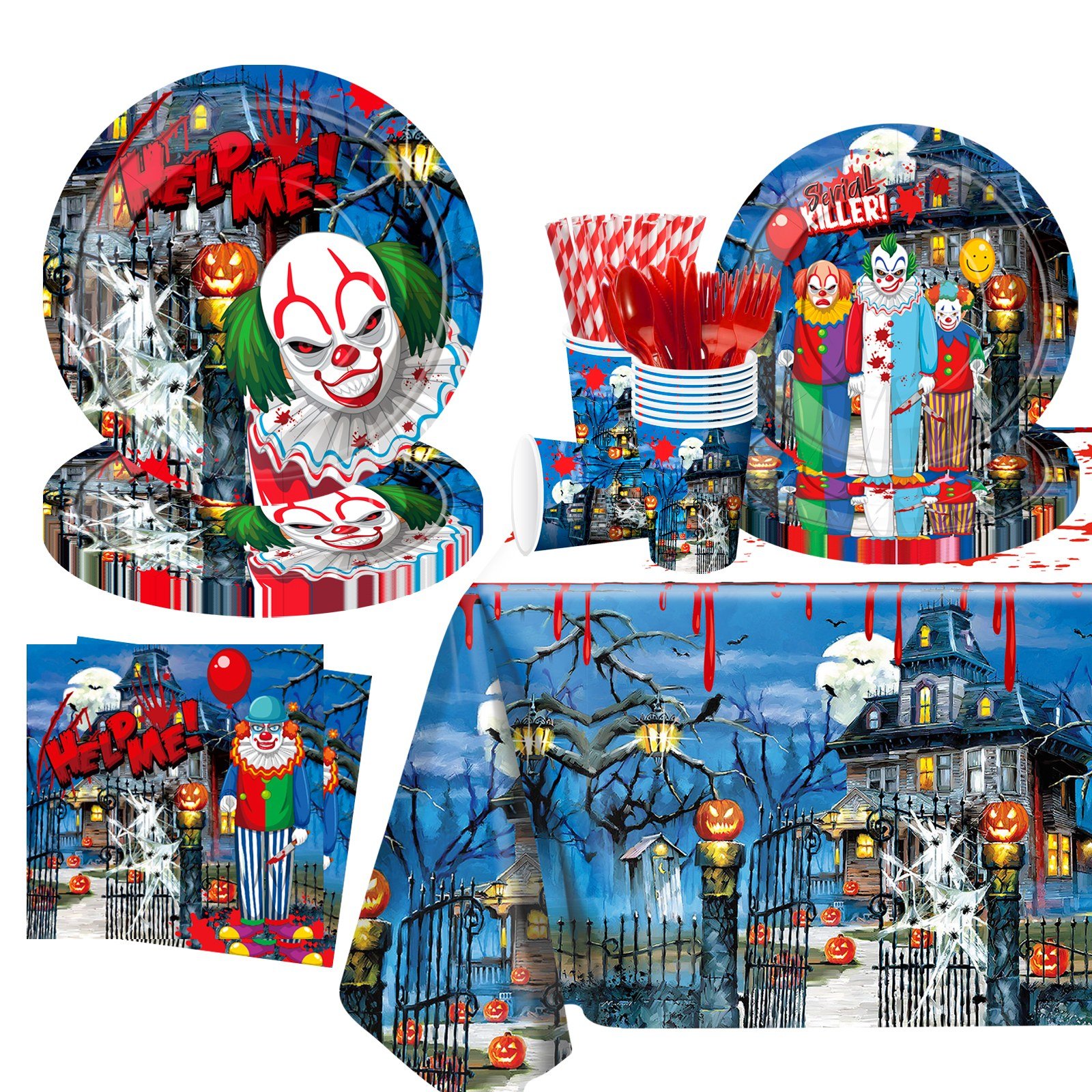
| Killer clown or graphic horror | Darker colours, bold faces, sharper imagery | Adult-themed parties |
| Muted adult Halloween | Black, cream, deep red, vintage graphics | Home entertaining and décor-led stores |
For family-oriented retail, buyers may consider a halloween pumpkin and ghost kids tableware set as a reference point for a friendly design direction. For adult-oriented assortments, a killer clown adult halloween tableware set illustrates how a darker design family can serve a different customer.
The key point is not to stretch one design in two opposing directions. A smiling ghost designed for young children may not translate convincingly into an adult horror collection. Likewise, a graphic clown or intense skull theme may be unsuitable for a supermarket family aisle. Buyers can carry both audiences, but they should treat them as separate design families.
A well-planned design brief normally identifies:
- Main icon or character group.
- Primary and secondary colours.
- Surface finish expectations.
- Target age and party audience.
- Products included in the series.
- Packaging style and retail message.
- Whether decorations should match the tableware.
For example, a classic pumpkin programme can extend naturally from plates and napkins into a halloween pumpkin party tableware set and selected matching décor. If a buyer adds decorations, the visual language should stay consistent. A coordinated classic halloween decoration set may be relevant where the retail plan calls for a complete party display rather than tableware alone.
Sizing the Assortment: Kids, Family and Adult Party Formats
A first-season assortment often becomes overcomplicated when buyers add too many sizes before confirming demand. The problem is not only inventory depth. Every additional format competes for shelf space, purchasing attention, packaging development, and forecast accuracy. A focused mix can create a clearer offer.
For most buyers, a small number of useful formats across one coordinated design family is more valuable than many sizes in only one artwork. Shoppers usually want a complete party solution. They are more likely to purchase matching plates, cups, and napkins than several plate diameters with no coordinated add-ons.
| Audience | Visual direction | Useful format focus | Assortment approach |
|---|---|---|---|
| Kids | Friendly icons, bright colour | Snack plates, cups, napkins | Keep graphics easy to understand |
| Family | Classic Halloween motifs | Meal plates, cups, napkins | Build a broad but practical set |
| Adult party | Horror, graphic, dark themes | Drinks, snacks, buffet formats | Use stronger visual distinction |
| Value retail | Clear seasonal icons | Core formats only | Limit complexity and duplication |
Buyers should assess the planned retail channel before selecting depth. A specialist party retailer may support several coordinated designs and multiple formats. A discount chain or supermarket may need fewer SKUs, clearer price architecture, and stronger shelf recognition. An e-commerce seller may favour bundles or design families that photograph well and are easy to list as coordinated sets.
The product specification needs to follow the intended use. A plate designed mainly for cake or snacks may have different functional expectations from a plate intended for a heavier party meal. Similarly, a beverage napkin and a luncheon napkin perform different roles at the table. Buyers should not assume that a visually matching item is automatically suitable for every food or beverage application.
A practical range review can ask:
- Which format gives the shopper the clearest party solution?
- Which items are essential to the buyer’s price point and shelf plan?
- Will the range be sold as individual packs, bundled sets, or both?
- Does each product create a clear reason for purchase?
- Can the display communicate kids, family, or adult positioning immediately?
This is also where photography matters. Shaped plates, die-cut napkins, and visually distinctive packs can create strong online images. However, buyers should discuss shaped formats separately because they can affect artwork preparation, tooling, production planning, and quotation structure.
Materials and Food-Contact Questions for Paper Tableware
Paper tableware can look similar in a catalogue while performing differently in real party use. A buyer may face complaints if a plate does not hold its shape under food or if a coating does not match the intended moisture or grease exposure. Material review should be part of supplier evaluation, not an afterthought.
Paper tableware is normally discussed in terms of board construction, board weight, printing, and coating. The appropriate specification depends on the intended food, serving duration, party format, and destination-market requirements. Buyers should provide the intended use clearly and obtain the relevant material details for the specific SKU.
| Feature | What it affects | Buyer question |
|---|---|---|
| Board weight | Plate stiffness and shape retention | Is the board suitable for intended food use? |
| Coating | Resistance to moisture or grease | What food exposure is expected? |
| Print coverage | Colour appearance and consistency | Does the artwork require full coverage? |
| Plate shape | Presentation and tooling needs | Is standard round or shaped format preferred? |
| Pack material | Retail appearance and protection | Does it support the sales channel? |
A standard round plate can offer a straightforward option for a broad programme. A shaped pumpkin, ghost, or bat plate may create stronger shelf impact, especially for children’s parties and online listings. Yet shaped formats are not merely a design variation. They can require a different tooling path, different production discussion, and separate commercial evaluation.
Buyers should use written questions instead of general terms such as “premium quality.” Useful questions include:
- What board construction is proposed for this format?
- What coating is proposed, and what use is it intended to support?
- Are the printed colours and finish represented in the sample?
- Does the sample show the final pack configuration?
- Are there limitations on food type, temperature, or duration of use?
- What food-contact documentation can be provided for the destination and application?
Requirements can vary by market and intended use. Buyers should confirm applicable food-contact, packaging, customs, and product requirements with their own compliance adviser or customs adviser before placing an order. A supplier’s documents should be reviewed as order-specific evidence, not treated as a universal answer for every destination.
The most reliable approval process links the material decision to the commercial use case. A party-store buyer may need colourful, lightweight packs for seasonal displays. A supermarket buyer may require a more controlled specification and consistent carton presentation. An online brand may prioritise protective packaging and product photography. Each need can influence the recommended construction.
Custom Print and Private Label for Halloween Designs
Generic Halloween products can struggle to stand out when several retailers carry similar orange-and-black graphics. Private label, custom artwork, packaging changes, and collection-based design can create differentiation. However, customisation needs an early and disciplined approval process because every design change can affect timing and quotation.
Halloween tableware wholesale buyers can customise at several levels. Some programmes focus on a unique surface print. Others need a retail-ready pack, brand label, barcode placement, carton markings, or coordinated decorations. The right level depends on the buyer’s brand strategy, forecast confidence, and channel requirements.
| Customisation level | Typical scope | Planning consideration |
|---|---|---|
| Existing design selection | Choose from available artwork | Fastest comparison route |
| Artwork adaptation | Change colours, icons, or pattern | Confirm design files and approval process |
| Private-label pack | Brand name, labels, packaging graphics | Review barcode and retail information |
| New themed collection | Original design across multiple SKUs | Requires fuller development discussion |
| Shaped product concept | Custom outline or die-cut presentation | Quote tooling path separately |
A buyer can explore the broader halloween party supplies range to identify design categories that may work across tableware and decorations. The final specification, however, should identify exactly what is being supplied. A mood board or online product image is not enough for production approval.
A useful custom-print brief includes:
- SKU or product format.
- Design reference or artwork file version.
- Required colours and finish.
- Pack count and retail packaging requirements.
- Private-label elements, if any.
- Outer-carton marking requirements.
- Destination market.
- Required delivery window for planning purposes.
- Any testing or documentation requests for buyer review.
Version control matters. Each approved item should have a dated and identifiable reference. If artwork changes after the sample stage, the buyer should clarify whether the change affects packaging, printing, dimensions, tooling, cost, or timing. This avoids a common problem: one team approves a product image while another team expects a different pack or finish.
Private-label buyers should also consider series consistency. A logo alone may not make the range feel branded. A consistent typography style, colour system, pack layout, and icon approach can help the collection look more intentional across plates, cups, napkins, and related party products.
MOQ, Sample Rounds and Specification Approval Before You Commit
A buyer may receive an attractive quotation but still face risk if the sample, artwork, pack configuration, and carton information are not approved in a controlled way. Halloween products have limited selling time, so unclear approval can lead to expensive corrections when there is little room to recover.
MOQ, sample availability, pricing, and production estimates should be confirmed for the specific SKU, customisation level, and destination. These details vary by product format and order composition. Buyers should avoid treating one quotation as automatically applicable to another design, pack, or shipment.
The most important principle is simple: approve a written specification, not only a photograph. A photograph can show colour direction and general appearance, but it may not confirm board construction, coating, dimensions, pack quantity, or carton markings.
| Approval item | Why it matters | Evidence to request |
|---|---|---|
| Artwork version | Prevents incorrect print | Dated artwork reference |
| Product dimensions | Confirms intended format | Specification sheet or approved sample |
| Board and coating | Supports functional evaluation | Written material description |
| Pack configuration | Controls retail presentation | Pack artwork and quantity confirmation |
| Carton markings | Supports warehouse receiving | Carton-marking layout or written approval |
A practical sample process may include an artwork review, a pre-production sample where appropriate, packaging review, and final specification sign-off. The exact sample route depends on the product and the amount of custom work involved. Buyers should state what each approval means. For example, approving artwork may not mean approving the final carton label.
This is especially important for mixed collections. A buyer may order plates, cups, napkins, decorations, and promotional add-ons from different production paths. Each item should still connect to a single master purchase record that identifies the correct design family, pack details, carton information, and destination.
When requesting a quote, give the supplier enough information to respond in one pass:
- SKU, design reference, or product category.
- Quantity required for each SKU.
- Destination country or port.
- Required delivery window for Halloween 2027 planning.
- Packaging and private-label requirements.
- Whether samples or custom artwork are needed.
- Any documentation or inspection expectations.
This level of detail helps a halloween tableware supplier identify the right quotation path. It also makes supplier comparison more meaningful because each quotation is based on the same assumptions.
Quality Control and Compliance Checks for Seasonal Party Goods
Seasonal party goods can arrive looking correct in a sample but still vary across a production run. Print registration, colour consistency, die-cut accuracy, pack count, and carton condition all affect the buyer’s ability to sell and distribute the goods. A quality plan should therefore focus on the approved specification.
The most useful inspection checks are measurable against the written approval record. If the buyer has not defined the board, pack, artwork version, and carton marking, an inspection team has less objective information to verify. The inspection process should be agreed before goods are released for shipment.
| Checkpoint | What to review | Why it matters |
|---|---|---|
| Print registration | Alignment of graphics and colours | Keeps character faces and patterns clear |
| Colour consistency | Match across production run | Supports coordinated-set appearance |
| Die-cut accuracy | Shape, edge quality, alignment | Important for shaped tableware |
| Coating coverage | Consistent surface treatment | Supports intended functional performance |
| Pack count | Quantity in each retail pack | Reduces retail and warehouse claims |
| Carton condition | Strength, labels, damage | Supports transport and receiving |
For a coordinated spooky party tableware collection, colour variation can be particularly visible. A pumpkin orange that changes noticeably between plates and cups can weaken the visual story. The same concern applies to black coverage, purple tones, metallic-style details, and high-contrast graphic artwork.
Inspection does not replace specification approval. It works with it. Buyers should first approve the product definition, then instruct inspection against that definition. A practical quality checklist may include:
- Correct design and approved artwork version.
- Correct product format and dimensions.
- Print placement and legibility.
- Surface finish and coating appearance.
- Clean die-cut edges where applicable.
- Correct retail pack quantity.
- Correct barcode, label, or private-label information.
- Correct inner and outer carton markings.
- Carton condition suitable for the agreed transport plan.
Compliance requirements depend on the destination market, the item’s intended use, and the buyer’s commercial route. Buyers should confirm applicable product, packaging, food-contact, and customs requirements with qualified compliance or customs advisers. Any supplier-provided documents should be checked against the actual SKU and destination rather than assumed to cover every market or product variation.
A buyer should also consider carton protection. Paper tableware can be lightweight, but retail packs may crush if cartons are poorly handled or loaded beneath heavier goods. This issue becomes more important when tableware ships in mixed Halloween containers.
Consolidating the Halloween Order and Requesting a Quotation
A mixed Halloween order can reduce purchasing complexity, but it can also create packing risks when paper tableware, lightweight decorations, and heavier products share the same shipment. Without clear carton planning, a consolidated order may arrive with avoidable compression damage or confusing receiving information.
The best consolidation plan starts with the destination and delivery requirement, then groups products by carton family, weight, fragility, and handling needs. Lightweight decorations should generally be protected from heavier tableware cartons, while retail packs should be arranged to reduce crushing and movement during transport.
| Consolidation factor | Buyer decision | Practical purpose |
|---|---|---|
| Destination | Port, warehouse, or distribution point | Aligns freight and documentation planning |
| Carton family | Similar size and protection needs | Improves loading logic |
| Product weight | Heavy versus lightweight goods | Reduces compression risk |
| Retail pack type | Hanging, boxed, bagged, wrapped | Protects presentation quality |
| Delivery window | Required warehouse arrival range | Supports freight planning estimates |
A buyer sourcing halloween plates cups napkins bulk may also source banners, hanging décor, party favours, or seasonal accessories in the same programme. This can make commercial sense when the products serve the same retail launch. Still, consolidation should not mean mixing every product without a loading plan.
The quotation request should be specific and easy to review. A supplier can respond more accurately when the buyer states the design, quantity, destination, customisation request, and preferred delivery window. If the order includes several product families, ask for the quotation to identify each SKU clearly rather than providing only one combined figure.
A useful RFQ can include:
- Product links, SKU references, or design images.
- Quantity required per design and format.
- Target destination and shipping preference, if known.
- Halloween 2027 required delivery window as a planning projection.
- Custom artwork, packaging, or private-label requirements.
- Whether the order should be consolidated with decorations or other seasonal goods.
- Required documentation for the buyer’s own review.
- Inspection or pre-shipment check requirements.
Buyers can use the request a quote page to send a structured enquiry. Include enough detail for the supplier to address MOQ, price, sample route, and estimated timing for the actual product combination. Final commitments should always be confirmed against the agreed specification, production arrangement, and shipping plan.
Frequently Asked Questions
What should a first Halloween tableware wholesale order include?
A first order usually works best with coordinated plates, cups, and napkins in a limited number of design families. Buyers can add selected decorations or accessories where the retail plan supports them. The right mix depends on the target shopper, channel, shelf space, destination, and expected party occasion.
Should buyers separate kids and adult Halloween tableware?
Yes. Kids and family parties usually suit friendly pumpkins, ghosts, and bright colours. Adult events may favour darker palettes, graphic horror themes, or more restrained styling. A buyer can carry both, but each should be treated as a distinct design family rather than one mixed collection.
Are shaped Halloween plates worth adding?
Shaped plates can improve shelf appeal and online product photography, especially for pumpkins, ghosts, bats, or character-led designs. However, they may involve different tooling and production considerations from standard round formats. Buyers should request a separate quotation and approval route for shaped items.
What information should be included in a Halloween tableware RFQ?
Include the SKU or design reference, quantity per item, destination, required delivery window, packaging needs, private-label details, and any sample or inspection request. This allows the supplier to provide a more relevant response on MOQ, pricing, estimated timing, and available customisation for the specific order.
Conclusion
Halloween tableware wholesale is most effective when plates, cups, napkins, and related party goods work as one coordinated retail story. Buyers planning Halloween 2027 should separate family and adult design directions, select practical formats, assess material and packaging requirements, and approve written specifications before production begins.
A clear RFQ reduces delays and makes supplier comparison easier. Send the SKU interest, quantity by item, destination, required Halloween 2027 delivery window, and any customisation or private-label needs through the request a quote page to begin a focused quotation discussion.
Hi, I'm Danson. I work closely with our manufacturing partners to develop and deliver seasonal decorations, party supplies, and celebration products for international wholesale buyers. Here, I share practical product knowledge, customization insights, and manufacturing experience to help buyers build successful seasonal collections.
Have a wholesale project in mind? Let's talk!
Discuss Your Wholesale Project Request a Wholesale QuotePlanning a Wholesale Order from China?
Share your product requirements, quantities and destination. Let's discuss your wholesale requirements.